Half the world’s food never feeds people — In America, it’s far worse

A recent One Earth-supported study from researchers at the University of Minnesota delivers a striking finding: global croplands already produce enough calories to feed roughly twice the world’s population, yet only about half of those calories actually make it onto our plates. In the United States, just 23% of the calories produced on croplands are consumed as food, while in India that figure is 82%. This dichotomy illustrates that policy and priorities can drastically change how we use land.
The finding arrives at a pivotal moment for global agriculture as it contends with how to feed a growing population without increasing its environmental harm. Croplands already occupy a vast portion of the planet and are a major driver of deforestation, freshwater depletion, and biodiversity loss. The study explores how we might use finite land wisely within these constraints.
For decades, the default response to food precarity has been to squeeze higher yields from the same land. But yield gains are slowing in many regions, and in some places the gap between current and potential harvests is widening. At the same time, as incomes rise in many countries the demand for meat increases. This leads to more crops being fed to livestock which is an inherently less efficient way to turn harvests into food.
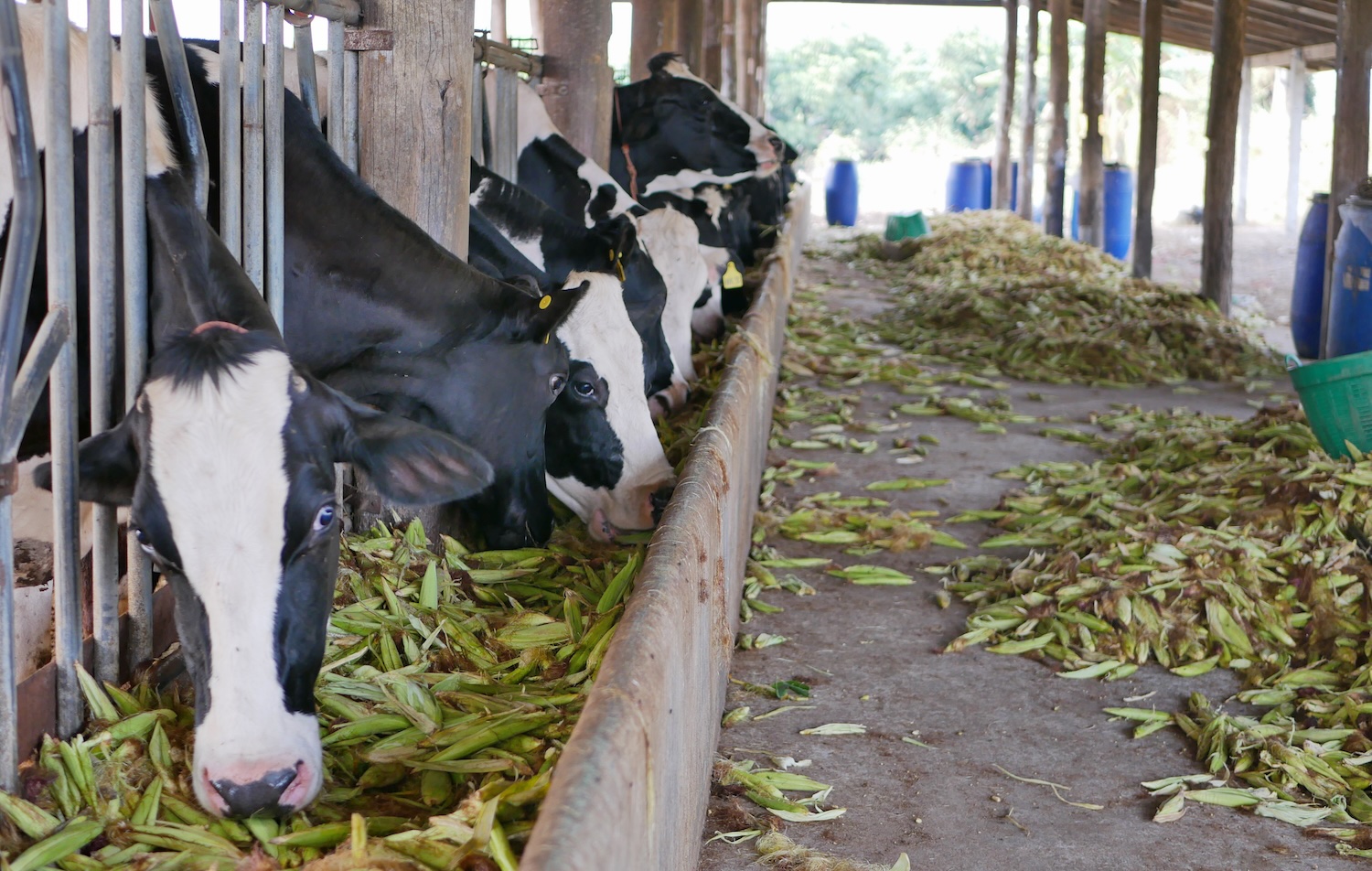
Dairy cows, raised in a farm, eating corn. Image credit: © Caewchiangmai | Dreamstime
Researchers are increasingly arguing that meeting future needs will require producing food on existing farmland while protecting and restoring large areas of nature. This vision is echoed by initiatives like the Global Safety Net, which calls for safeguarding roughly half of Earth’s lands to maintain ecological stability.
Understanding the different efficiencies of how croplands are turned into food is therefore not just a question of hunger, but of how we balance nourishment with planetary health.
To understand how well today’s agricultural land is actually feeding people, the researchers analyzed how the world’s 50 most calorie-producing crops are used. They tracked whether harvests ended up as direct human food, livestock feed, biofuels, or other non-food products. By pairing global production data with feed-to-food conversion efficiencies, they calculated how many of the calories grown on croplands ultimately become available for human diets.
What the researchers found is a picture of a food system defined less by scarcity than by allocation. Between 2010 and 2020, global calorie production from crops rose by nearly 24%, yet the calories actually available to people grew by only about 17%. Nearly half of all these calories are diverted away from direct human consumption, primarily into livestock feed and, to a smaller but significant extent, biofuels.
Meat production, especially beef, emerged as the single largest source of inefficiency. Cattle require roughly 33 calories of feed to produce just one calorie of edible meat, accounting for a substantial share of the calories effectively lost in the system. Meanwhile, a growing portion of cropland harvests is used to produce fuels rather than food, illustrating how decisions about what we grow and what we grow it for shape the meaningful output of our agricultural landscapes.
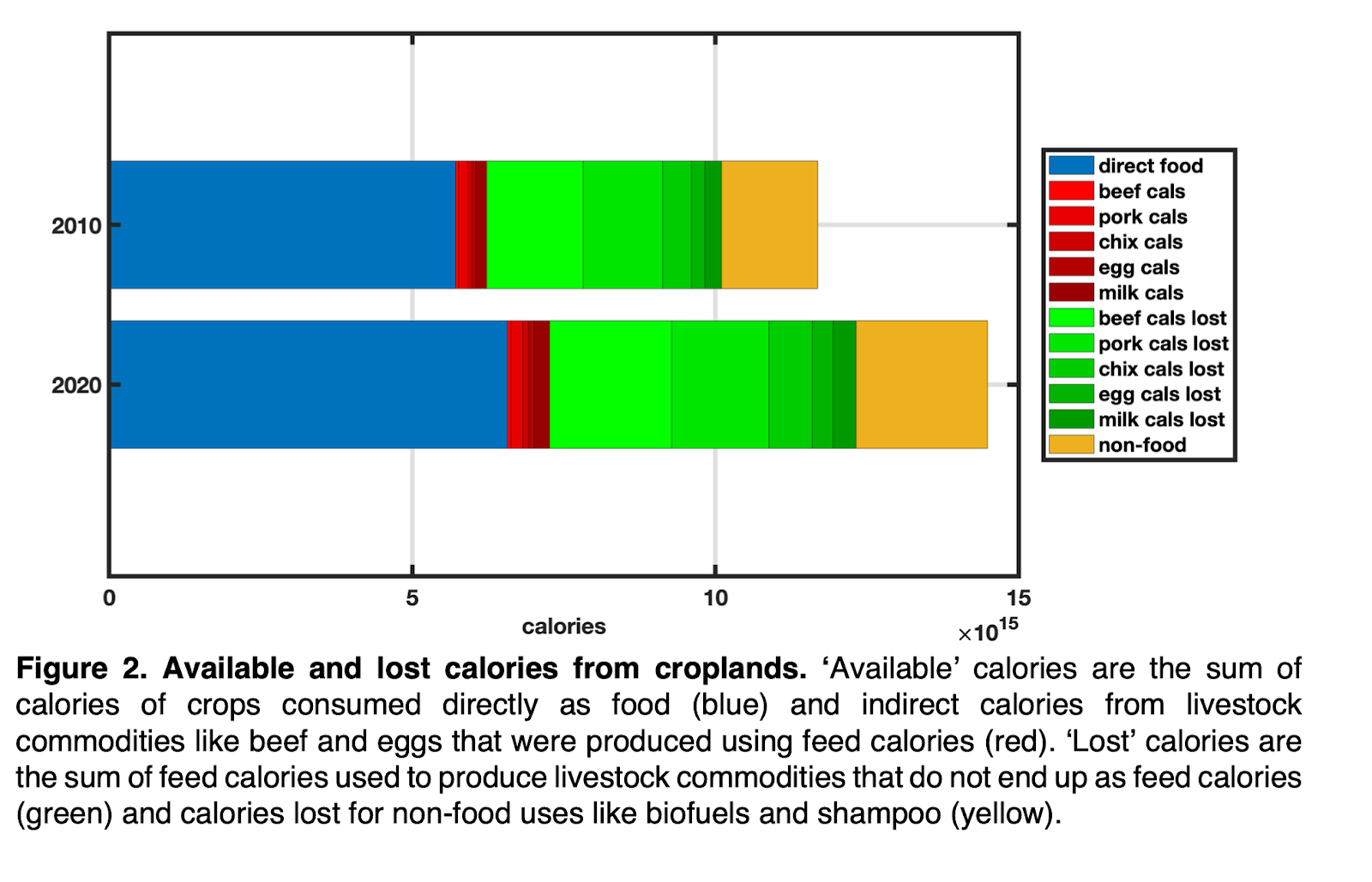
Taken together, the numbers point to a striking conclusion: croplands already produce enough calories to support about 14.5 billion people—nearly double today’s population—yet hundreds of millions still experience hunger and billions face food insecurity. The gap reveals that the central challenge is less biophysical limits and more a matter of how efficiently land is used.
The study finds that if higher-income countries reduced excess beef consumption to levels recommended by the EAT–Lancet diet and replaced it with chicken, the calories saved could meet the needs of roughly 850 million people. Shifting that same excess beef to plant-based proteins like lentils could free enough calories to feed more than a billion. Improving how cropland is allocated could therefore help meet nutritional needs without expanding agriculture into remaining natural ecosystems that are essential to planetary health.
The stakes extend far beyond calories: agriculture is responsible for roughly a fifth of global greenhouse gas emissions, dominates freshwater use, and remains the leading driver of deforestation. Using existing farmland more efficiently offers a rare systems-level opportunity to reduce climate pressures, protect biodiversity, and strengthen food security simultaneously.
The study’s message is ultimately pragmatic: the path to a more resilient food system runs through a relatively small set of decisions. Because much of the inefficiency is concentrated in a handful of commodities and countries, targeted shifts could yield outsized benefits. Reducing excess beef consumption in the United States and Brazil—who are responsible for a majority of meat inefficiencies—and rethinking biofuel policies in the United States, Brazil, the European Union, and Indonesia would significantly increase the amount of food available from existing croplands.
In a world facing simultaneous pressures of climate change, biodiversity loss, and food insecurity, smarter land-use choices offer one of the clearest opportunities to nourish people while safeguarding the ecosystems we depend on.
Explore similar content

Subscribe to receive monthly updates on climate solutions, environmental heroes, and the profound beauty and wonder of our shared planet Earth.