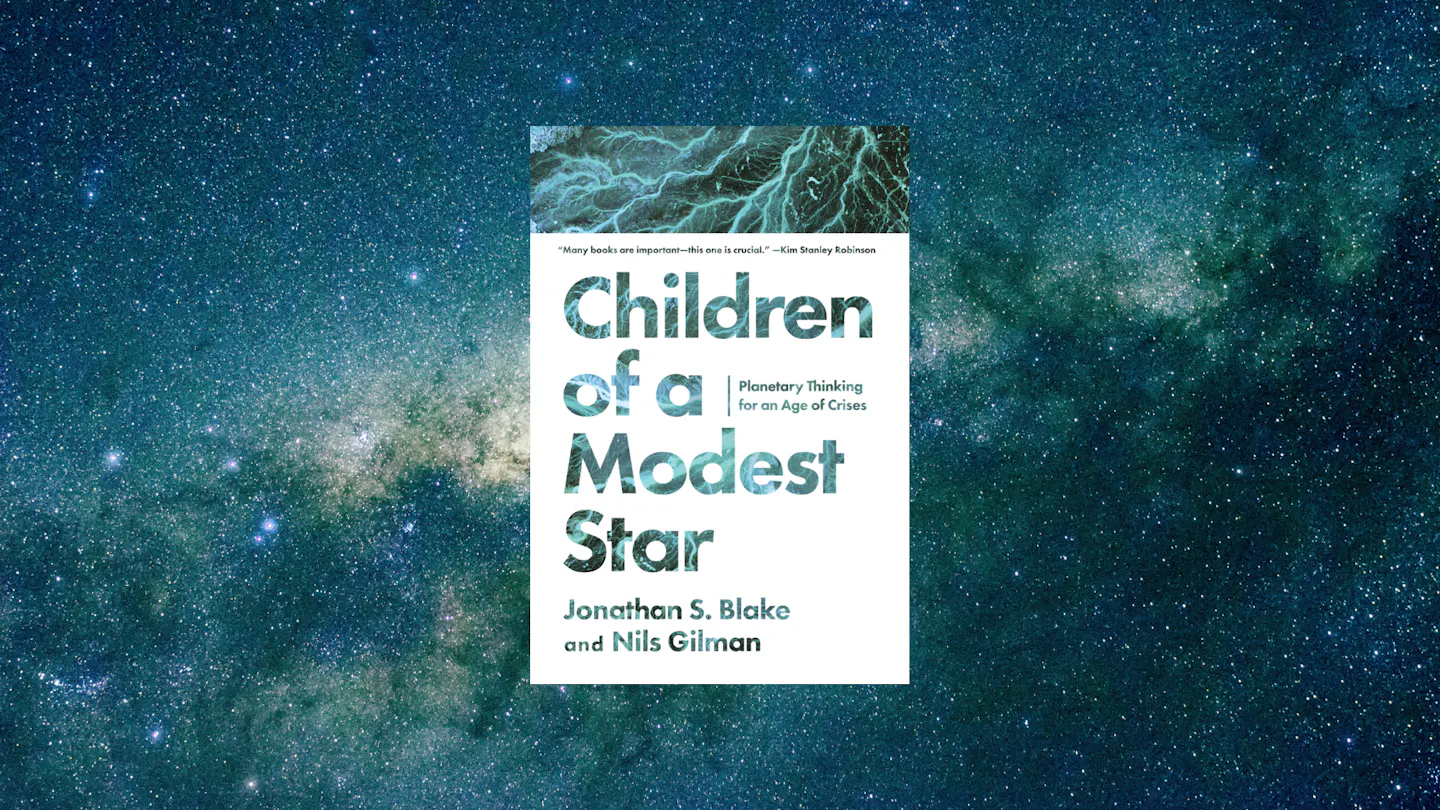
Children of a Modest Star and the search for governance that fits a living planet

Jonathan S. Blake and Nils Gilman’s Children of a Modest Star: Planetary Thinking for an Age of Crises asks a large political question: what kind of governance makes sense on a planet defined by climate change, pandemics, biodiversity loss, and deep ecological interdependence?
The authors say from the outset that the book is “not a white paper or a policy report,” but a broader effort to rethink how political authority is organized in a time when our planet is in crisis.
Seeing crisis at planetary scale
The book opens with COVID-19 as an example of how one event can be human, biological, and planetary at the same time. Blake and Gilman describe the pandemic as a “multispecies event,” tracing how the virus moved across species and how the global human response briefly changed atmospheric conditions, producing what they call “the largest ever decline in emissions.”
From the start, the authors suggest that contemporary governance systems are poorly matched to problems of this scale. Their central question is what governance would look like if humanity’s embeddedness in Earth systems were treated as politically central rather than secondary.

The Venice Canals run clear amid coronavirus lockdown, so much so that dolphins appear in the famous Italian waterways. Image Credit: Canva/Twitter.
How the nation-state came to dominate
A major part of the book is historical. Blake and Gilman present the idea that the nation-state is not a timeless or natural political form, but one that became globally dominant only in the mid-twentieth century. They write that since about 1965, national states have been treated as the only legitimate holders of sovereignty in international society.
The book links that shift to decolonization and postwar development. Political self-determination and economic development became intertwined, and the national state came to be seen as the primary framework for both. By the early 1960s, the authors argue, that combination had made the national state the “lone viable vehicle” for legitimate governance.
A world that is already governed at many levels
Even so, the book shows that actual governance no longer fits neatly inside the borders of nation-states. International organizations, local governments, nonstate actors, treaties, and transnational networks all now play major roles in managing public life. Yet, as the authors put it, “while operational responsibilities have migrated, sovereignty has not.”
That tension is especially clear in climate governance. The book describes today’s system as multilevel, involving UN bodies, the European Union, national governments, municipalities, corporations, NGOs, and local communities. But because the national state remains sovereign, it still acts as the foundation of the whole system.
Blake and Gilman use the Kyoto Protocol and the Paris Agreement to show the limits of this arrangement. Kyoto had stronger binding rules but lacked participation from major emitters, while Paris secured wider participation by relying on voluntary national commitments. In the book’s account, both reveal the same basic problem: planetary issues remain anchored in institutions built around state sovereignty.
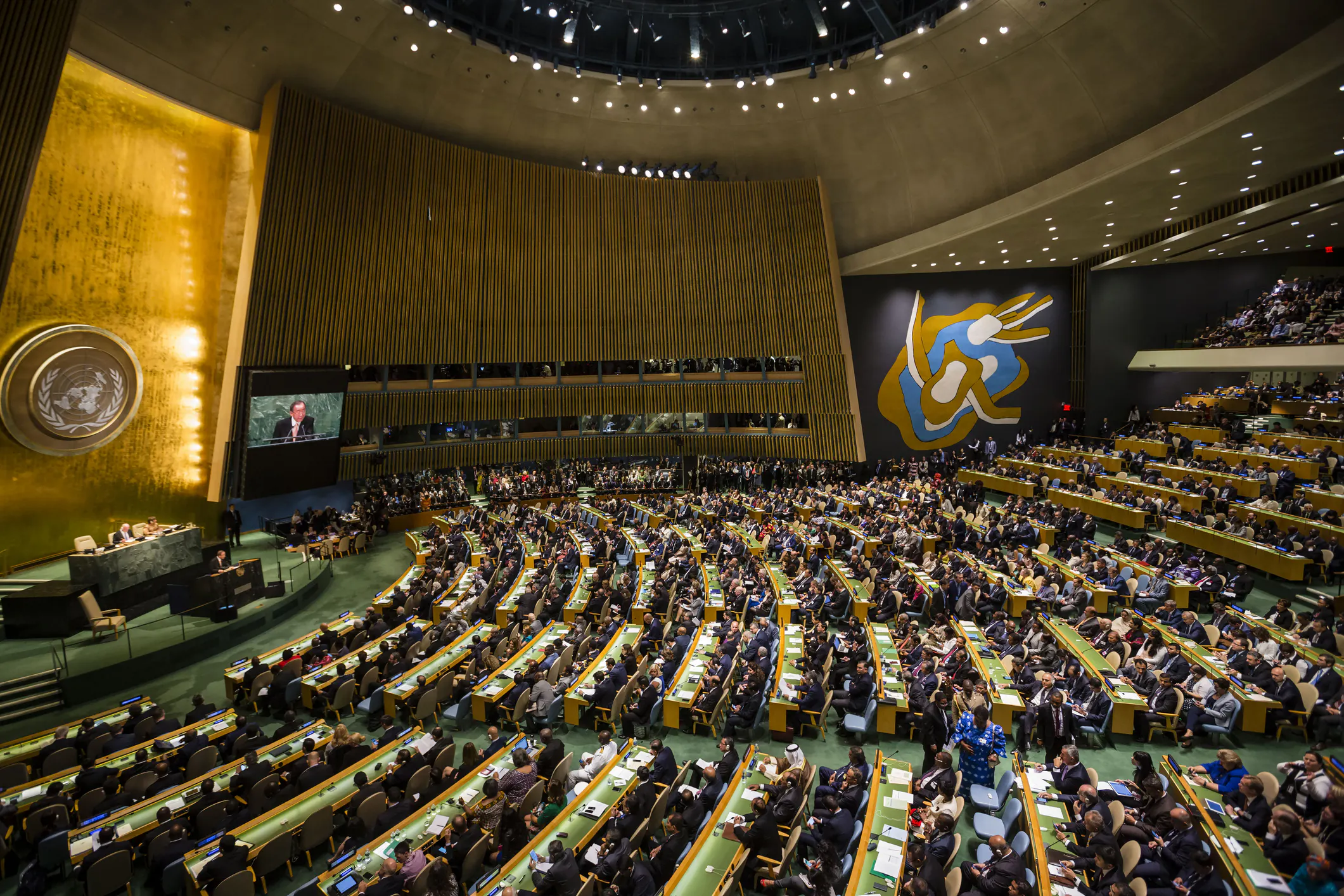
The UN General Assembly helped define a new era of international cooperation. But as today’s crises move through shared planetary systems, the task before us is to imagine forms of collective action that reach beyond national interests alone. Image Credit: © Palinchak, Dreamstime.
The idea of planetary subsidiarity
The book’s main proposal is what the authors call planetary subsidiarity. In simple terms, it means assigning authority to the smallest scale that can govern a problem effectively, rather than assuming that one scale of governance is always best. “The focus should be on getting the scale right,” they write, not favoring any one level by default.
Under this framework, some issues would remain local, some would be national, and some would need to be planetary. The book proposes that governance should start with the function of the problem itself, then build or empower the institution that can address it.
Local institutions for local issues
The authors make the case that that many issues now handled by national governments would be governed more effectively at smaller scales, not because local communities are inherently better, but because local institutions are often closer to the conditions they are trying to manage.
One of the book’s main examples is Jakarta’s flooding and its partnership with Rotterdam. The two cities are very different in national terms, but the authors note that they face similar functional challenges as low-lying, flood-prone urban regions. Their collaboration, along with city networks like C40, a global network of nearly 100 cities working together to tackle climate breakdown, shows how local institutions can learn from one another across borders and share practical responses to common threats.
The book also emphasizes that local governance does not mean rigid existing boundaries. Some problems, the authors note, should be managed at the scale of a watershed, ecosystem, or urban agglomeration, even when those units do not line up with current political borders.
Planetary institutions for planetary problems
At the same time, Blake and Gilman contend that some problems cannot be governed effectively below the planetary scale. Climate change and pandemics are their clearest examples, because both move across borders through atmospheric and ecological systems that no nation-state controls.
To illustrate what planetary governance might look like, the book sketches two institutions. One is a Planetary Atmospheric Steward, which would combine climate knowledge with the authority to set enforceable greenhouse gas limits. The other is a Planetary Pandemic Agency, which would monitor disease emergence, regulate upstream drivers such as deforestation and wildlife trade, and coordinate vaccines and therapeutics at the scale of the whole planet.
The authors stress that these are not proposals for a world state. They describe them instead as “minimum viable planetary governors,” meaning narrowly focused institutions with enough authority to govern a specific planetary issue, while leaving implementation details to national and local levels.
Rethinking sovereignty on an interdependent Earth
A large part of the book involves rethinking sovereignty itself. The authors suggest that the traditional model of sovereignty as freedom from outside interference no longer fits a world where carbon, microbes, and ecological disruption move regardless of borders. Under planetary conditions, they suggest, communities need forms of governance that can actually secure the conditions for life, not just preserve formal independence.
The conclusion does not call for abolishing nation-states overnight. Instead, it imagines them taking on a different role within a broader multiscalar system, serving as administrators of planetary directives and as supporters of local institutions, translocal networks, and new planetary bodies.

Taken by Voyager 1 in 1990, the “Pale Blue Dot” shows Earth from 3.7 billion miles away, revealing our planet as a faint speck in the vast cosmos and inspiring a deeper sense of humility, compassion, and care for our shared home. Image Credit: NASA.
The meaning of a modest star
The title comes from W. H. Auden’s phrase “the children of a modest star,” which the authors use to frame the book’s closing argument. They describe the challenge of learning “who and where and how we are” on Earth, and they call for forms of governance that reflect humanity’s embeddedness in the biosphere and its responsibility within it.
The conclusion returns to five guiding ideas, including multispecies flourishing, planetary knowledge, institutional effectiveness, the transformation of the national state, and a revised understanding of sovereignty. One of its clearest lines states that “A thriving biosphere is the sine qua non of everything else,” placing ecological habitability at the center of political life.
In the end, Children of a Modest Star presents a summary argument that runs through the whole book. The nation-state became dominant for historical reasons, but many of the most urgent crises now exceed its scale. The authors’ answer is a system of governance organized around the size and nature of the problem, with stronger local institutions for local issues and shared institutions for challenges that affect the whole planet.

Subscribe to receive monthly updates on climate solutions, environmental heroes, and the profound beauty and wonder of our shared planet Earth.