.png?auto=compress%2Cformat&w=1440)
Why the marbled polecat is one of the most unusual mustelids on Earth
- Nature Conservation
- Land Conservation
- Iconic Species
- Mammals
- Wildlife
- Persian Deserts & Forests
- Central Eurasia Realm

One Earth’s “Species of the Week” series highlights an iconic species that represents the unique biogeography of each of the 185 bioregions of the Earth.
The marbled polecat (Vormela peregusna) is one of the most striking and little known members of the weasel family. With a boldly patterned coat, oversized ears, and a powerful defensive scent, this small predator has evolved to survive across some of Eurasia’s harshest open landscapes. Though rarely seen, it plays an important ecological role in grasslands and semiarid regions that are increasingly under pressure.

In the One Earth Bioregions Framework, marbled polecats are the iconic species of the Afghan-Balochistan Drylands, Mountain Meadows & Conifer Forests bioregion (PA30), located in the Persian Deserts & Forests subrealm of Central Eurasia.
Life across dry grasslands and deserts
Marbled polecats are generally found in dry, open environments stretching from southeastern Europe across the Balkans and the Caucasus, through the Middle East and Central Asia, and eastward into northern China and southern Mongolia. They inhabit deserts, semideserts, steppe country, rocky upland valleys, low hill ranges, and arid scrub forests, while avoiding high mountain regions. Despite their preference for wild landscapes, they are sometimes seen in cultivated areas such as melon patches and vegetable fields.
A small predator with dramatic markings
This species measures about 29 to 35 centimeters (11.4–13.8 in) from head to body and has a long, bushy tail. Its short muzzle and very large ears give it a distinctive profile, while short limbs and strong claws make it well suited for digging.
The face is boldly marked with black and white, including a dark stripe across the eyes and pale areas around the mouth. The back is yellow and heavily mottled with reddish or brown spots, giving the animal its marbled appearance.
Females typically weigh between 295 and 600 grams (10.4–21.2 oz), while males are slightly heavier at up to 715 grams (25.2 oz).
A highly adaptable and opportunistic diet
Marbled polecats feed on a wide range of prey, reflecting their adaptability. Their diet includes ground squirrels, Libyan birds, Armenian hamsters, voles, mole rats, mice, small hares, lizards, fish, frogs, snails, and insects such as beetles and crickets. They also consume fruit and grass and have been recorded taking small domestic poultry, as well as stealing smoked meat and cheese when the opportunity arises.
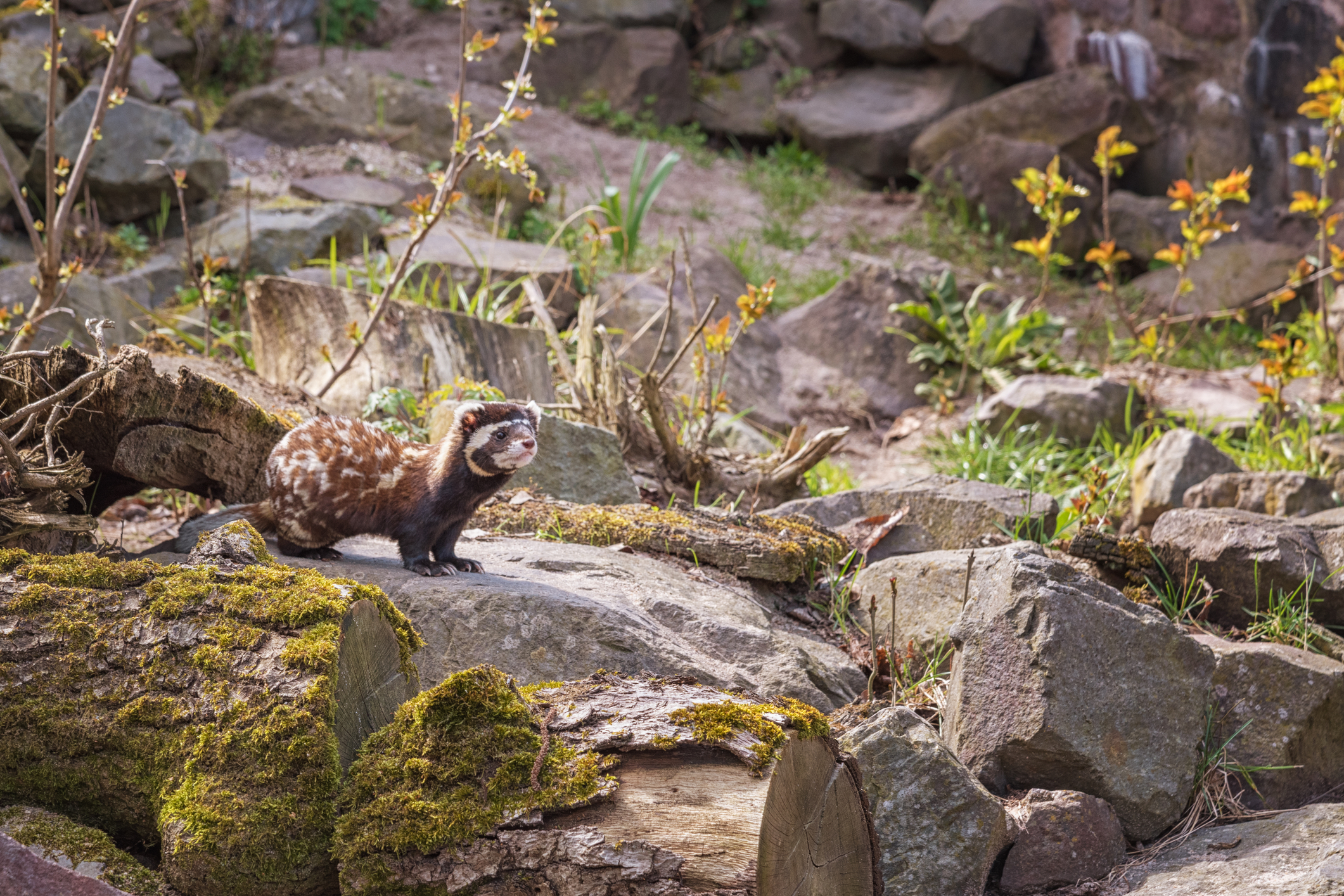
Bold black-and-white facial markings and a marbled yellow coat help the marbled polecat blend into the dry grasslands, steppes, and semiarid landscapes it calls home. Image Credit: © Nataliavo, Dreamstime.
Keeping rodent populations in check
As active predators of small mammals, marbled polecats help regulate rodent populations across open landscapes. By hunting species such as ground squirrels and birds, they influence prey dynamics in ecosystems where rodents can otherwise become overabundant. This role ties the polecat closely to the health and balance of steppe and semiarid environments.
Solitary behavior and powerful defenses
Marbled polecats are mostly active during the morning and evening hours. Their eyesight is weak, but this is offset by a highly developed sense of smell. They are solitary animals that move across home ranges of roughly half a square kilometer and tend to remain in a single shelter at a time. Encounters between individuals are often aggressive.
When threatened, a marbled polecat adopts a dramatic defensive posture, arching its back, raising its body on stiff legs, and curling its tail over its back with the fur fully erect. It may bare its teeth and emit shrill hisses. If the threat persists, it can release a strong-smelling secretion from enlarged anal glands beneath the tail, a defense shared with other members of its subfamily.
Burrows, dens, and underground life
To rest and breed, marbled polecats typically use the abandoned burrows of large rodents such as great gerbils and Libyan birds. They may also dig their own dens or take shelter in underground irrigation tunnels. In winter, these dens are lined with grass for insulation. When excavating, the polecat digs with its forelegs while bracing itself with its chin and hind legs, using its teeth to remove roots and other obstacles.
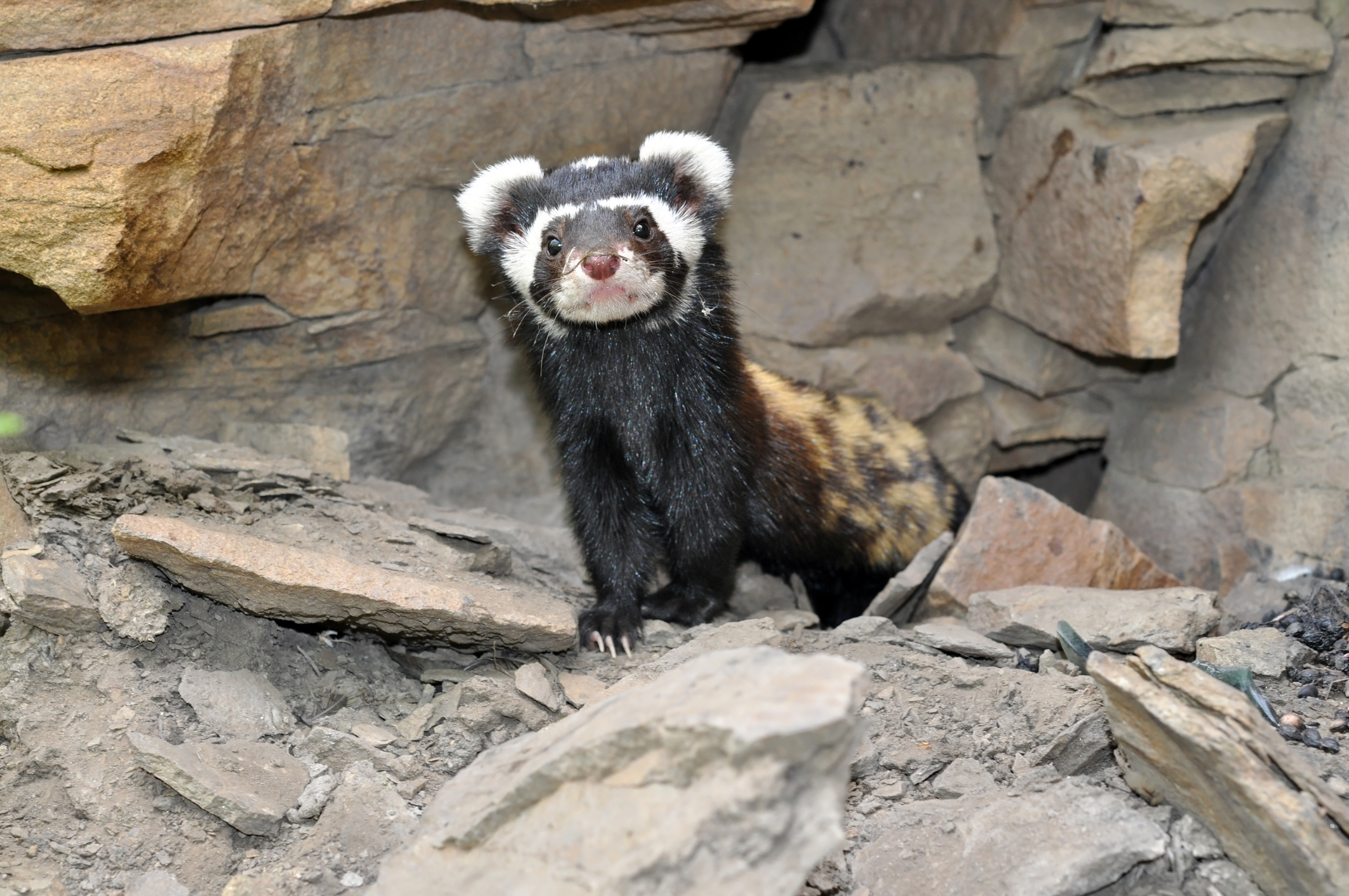
A marbled polecat spotted in Regional Landscape Park Zuevsky, Ukraine. Image Credit: © Evgovorov, Dreamstime.
A slow and carefully timed life cycle
Mating occurs from March to early June, with males producing low, rumbling calls during the breeding season. Gestation is unusually long and variable, lasting between 243 and 327 days due to delayed implantation. This adaptation allows births to occur from late January to mid-March, when conditions and prey availability are more favorable.
Litters typically consist of four to eight cubs. Females alone care for the young, which open their eyes after about 38 to 40 days. Cubs are weaned at around 50 days and disperse from their mother at roughly two months of age.
Pressures from habitat loss and poisoning
In 2008, the marbled polecat was classified as Vulnerable on the IUCN Red List after evidence showed population declines of at least 30% over a ten-year period. Previously, it had been listed as Least Concern.
The marbled polecat faces several human-driven threats. It was once heavily hunted for its fur, known in the trade as fitch or perwitsky. Today, the most significant pressures come from habitat loss and declines in prey populations caused by the widespread use of rodenticides. These poisons reduce available food and can also directly harm polecats that consume contaminated prey.
A rare predator worth protecting
The marbled polecat is a reminder that even small, elusive predators can play outsized roles in maintaining ecosystem balance. Protecting open grasslands and reducing the use of rodenticides will be essential to securing the future of this vividly patterned hunter, whose survival is closely tied to the health of Eurasia’s dry landscapes.
Explore similar content

Subscribe to receive monthly updates on climate solutions, environmental heroes, and the profound beauty and wonder of our shared planet Earth.
What is an Iconic Species?
An iconic species is a charismatic and ecologically significant animal selected to represent the unique biogeographical diversity of each bioregion in One Earth's Bioregions Framework. Learn more >