Meet the pink-footed goose: An Arctic bird built for distance
- Nature Conservation
- Land Conservation
- Iconic Species
- Wildlife
- Birds
- Scandinavia & West Boreal Forests
- Subarctic Eurasia Realm

One Earth’s “Species of the Week” series highlights iconic species that represent the unique biogeography of each of the 185 bioregions of the Earth.
On autumn mornings in Northern Europe, the sky can fill with sound before the birds appear. Then the flocks arrive, long ribbons of geese calling sharply as they sweep down toward fields and wetlands.
These are pink-footed geese (Anser brachyrhynchus), medium-sized Arctic migrants whose lives are shaped by long journeys between some of the planet’s most remote breeding grounds and its most intensively farmed landscapes.

In the One Earth Bioregions Framework, the pink-footed goose is the iconic species of the Iceland bioregion (PA2), part of the Scandinavia & West Boreal Forests subrealm located in Subarctic Eurasia.
Life between tundra and temperate farmland
Pink-footed geese breed in eastern Greenland, Iceland, Svalbard, and, more recently, Novaya Zemlya, an archipelago in northern Russia. These high Arctic regions are defined by glaciers, windswept tundra, and sparse vegetation.
When winter approaches, the geese migrate south to northwestern Europe, especially Ireland, Great Britain, the Netherlands, and western Denmark. There they gather in enormous numbers on grasslands, lakes, estuaries, and agricultural fields, creating some of the most dramatic seasonal wildlife spectacles in the region.
Built for endurance and the cold
This species measures about 60 to 75 centimeters (24-30 in) in length, with a wingspan reaching up to 170 centimeters (53-67 in) and a weight of roughly 1.8 to 3.4 kilograms (4-7.5 lb).
Its name comes from its bright pink feet and the pink band across a short bill that is otherwise black at the base and tip. The body is mid gray-brown, with a darker head and neck, white rump and vent, and a gray tail tipped in white. In flight, the blackish gray feathers and pale wing coverts stand out, especially when thousands move together.
A grazing bird with a flexible palate
Pink-footed geese are almost entirely herbivorous. During summer, they feed on a wide variety of tundra plants, foraging both on land and in shallow water. In winter, their diet shifts to oilseed rape, sugar beet, potatoes, and grasses found on farmland. While this grazing can cause crop damage, it can also benefit farmers by removing leftover leaves and roots after harvest, helping reduce crop disease transmission between seasons.
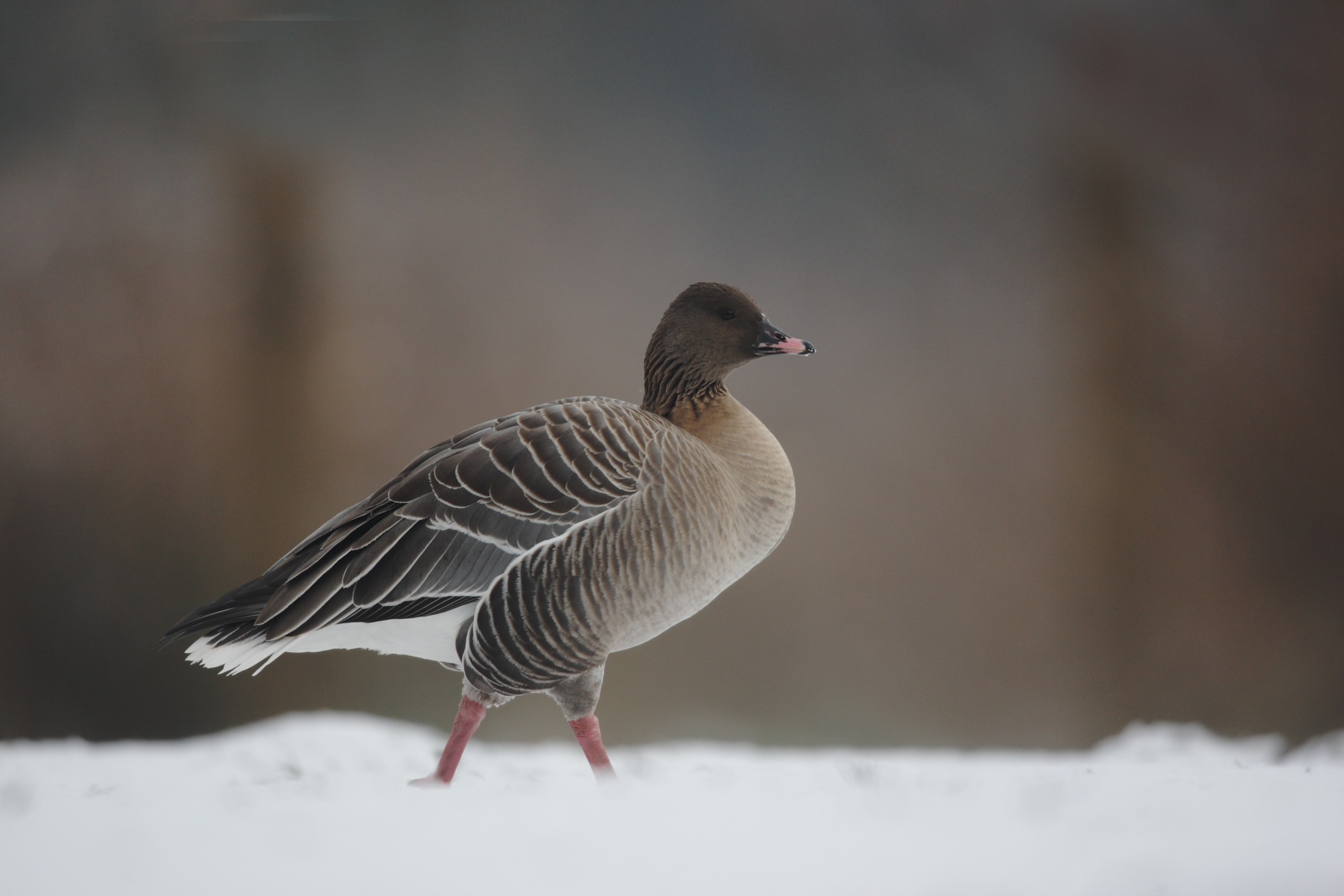
Pink-footed goose standing in snow. Image Credit: © Mikelane45, Dreamstime.
Shaping landscapes through numbers
By grazing in large flocks, pink-footed geese influence plant growth in both Arctic and agricultural ecosystems. Their feeding redistributes nutrients across fields and wetlands, and their seasonal movements link distant regions through the flow of energy and biomass. In wintering areas, tens of thousands of birds can concentrate in a single location, turning open fields into hubs of ecological activity.
Social lives and epic movements
These geese are highly vocal, producing high-pitched honking calls that can be almost deafening in flight. Family groups are notably strong. Adults lead their young on foot from nesting sites to nearby lakes, sometimes walking long distances across tundra before the goslings can fly. Migration south typically occurs from mid-September to early October, with the return north taking place from mid-April to early May.
From egg to long-lived adult
Nesting often occurs on cliffs near glaciers or on islets in lakes, locations that help protect eggs from predators such as Arctic foxes. Females lay three to six eggs in late spring, with incubation lasting about 26 to 27 days. After hatching, goslings stay with their parents and fledge roughly 56 days later. Pink-footed geese can be remarkably long-lived, with the oldest recorded individual reaching more than 38 years.
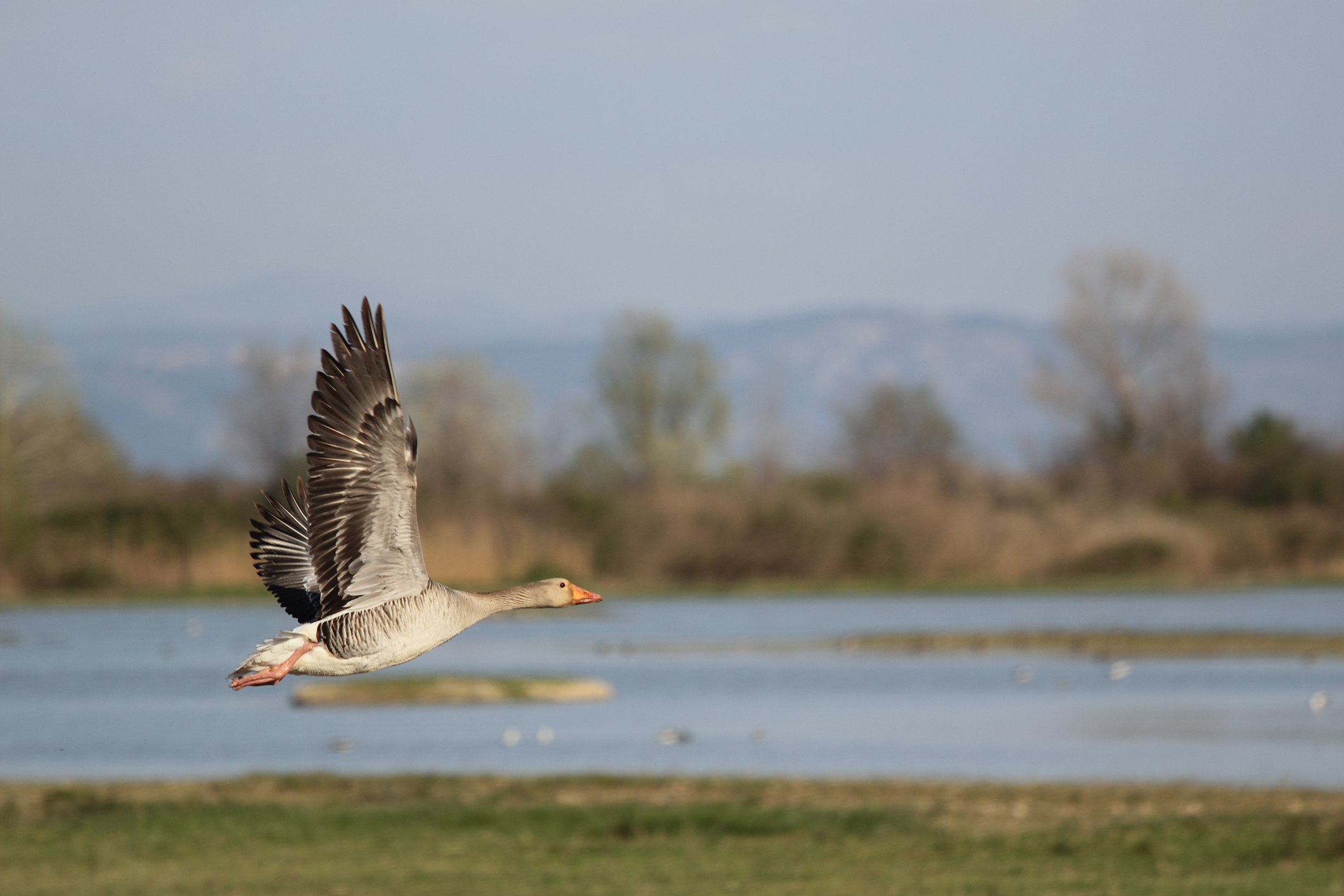
The pink-footed goose in flight at birdwatching reserve, Isola della Cona. Image Credit: © Emel82, Dreamstime.
Climate change and expanding horizons
In recent years, the species has shown a striking ability to adapt. A new breeding population has rapidly formed on Novaya Zemlya, originating from the Svalbard birds. This expansion, documented within a decade, is thought to be linked to a warming climate that has made the region more suitable for breeding, as well as the geese’s capacity for social learning and cultural transmission. The new population numbered several thousand birds by 2023.
A species protected through cooperation
The pink-footed goose is classified as Least Concern on the IUCN Red List. Its population has increased dramatically over the past 50 years, largely due to improved protection from shooting on wintering grounds. The species is covered by the Agreement on the Conservation of African-Eurasian Migratory Waterbirds, which promotes international cooperation along its migratory routes.
A resilient migrant in a changing world
From Arctic cliffs to European croplands, the pink-footed goose embodies the challenges and possibilities of life on a warming planet. Its growing numbers and expanding range offer a rare conservation success story, while its dependence on multiple regions underscores how deeply connected distant ecosystems have become. As climate and land use continue to shift, the future of this traveler will depend on careful stewardship across the full span of its remarkable journey.
Explore similar content

Subscribe to receive monthly updates on climate solutions, environmental heroes, and the profound beauty and wonder of our shared planet Earth.
What is an Iconic Species?
An iconic species is a charismatic and ecologically significant animal selected to represent the unique biogeographical diversity of each bioregion in One Earth's Bioregions Framework. Learn more >