The addax: A vanishing ghost of the Sahara
- Nature Conservation
- Land Conservation
- Iconic Species
- Wildlife
- Mammals
- North Africa
- Southern Eurasia Realm

Across the Sahara, where rainfall can be scarce and vegetation appears only in scattered patches, the addax has evolved to endure conditions that would challenge most other large mammals. Also known as the white antelope or screwhorn antelope, the addax (Addax nasomaculatus) is the only living member of its genus and one of the Sahara’s most distinctive antelopes.
Its pale coat reflects the desert sun. Broad hooves carry it across soft sand. Moisture drawn from grasses, leaves, and even dew allows it to survive for extraordinary periods without free-standing water. Yet, adaptations that have sustained the addax in one of Earth’s harshest environments have offered little protection against its greatest threat: humans.
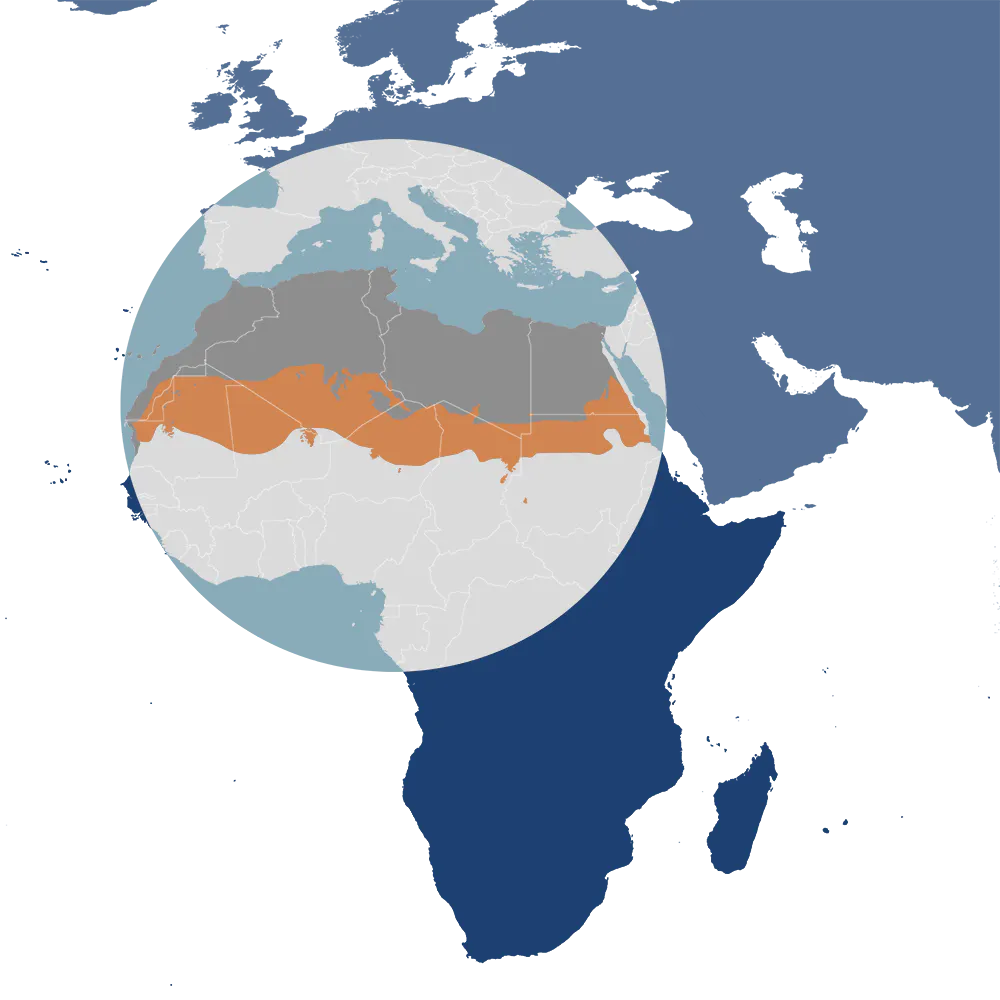
The addax is the iconic species of the Southern Sahara Deserts & Mountain Woodlands bioregion (PA25), located in the North Africa subrealm of Southern Eurasia.
A life built for the world's harshest desert
The addax makes its home in the arid regions, semideserts, and sandy and stony deserts of North Africa, thriving in places that receive less than 100 millimeters (3.9 in) of rainfall a year. It favors deserts scattered with tussock grasses and succulent thorn scrub, landscapes that would look like wasteland to almost any other grazer.
Historically, the addax's range stretched across the Sahelo-Saharan region west of the Nile Valley, touching nearly every country that shares the Sahara. That range has collapsed dramatically. The only known self-sustaining population today lives in the Termit Massif Reserve in Niger, with additional sightings reported in the eastern Air Mountains of Niger and the Bodélé region of Chad.
Scattered nomads may still wander through northern Niger, southern Algeria, and Libya, and rumors persist of addax along the Mali-Mauritania border, though none have been confirmed. The species is now extinct in Algeria, Egypt, Libya, Sudan, and Western Sahara, and it has been reintroduced to parts of Morocco and Tunisia.
A coat that changes with the seasons
The addax's head to body length runs 1.2 to 1.3 meters (3.9–4.3 ft), with a tail measuring 25 to 35 centimeters (9.8–13.8 in). Males stand 1.05 to 1.15 meters (3.4–3.8 ft) at the shoulder and weigh 100 to 125 kilograms (220–276 lb), while females are smaller, standing 0.95 to 1.1 meters (3.1–3.6 ft) tall and weighing 60 to 90 kilograms (130–200 lb).
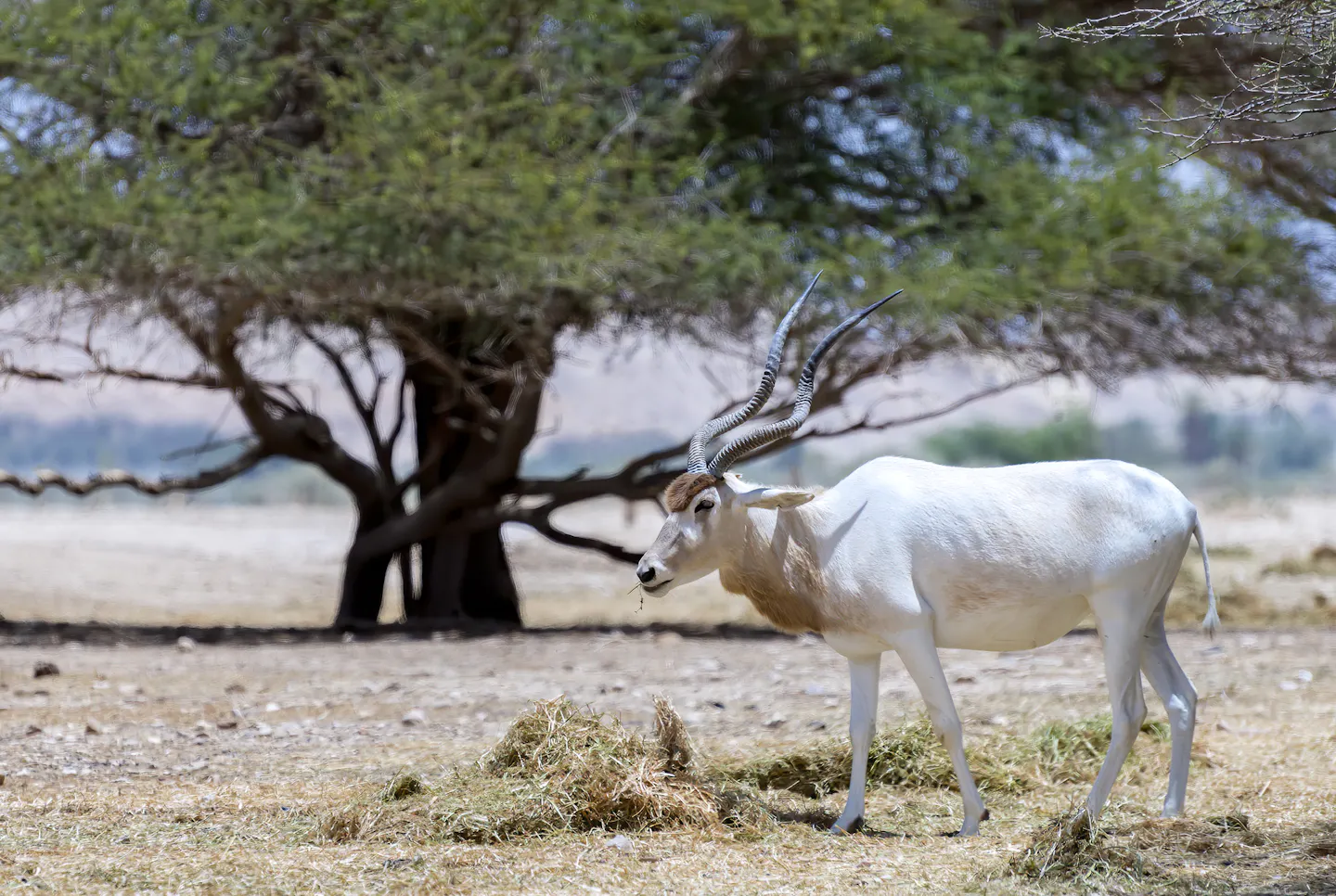
Few animals wear their adaptation to climate as visibly as the addax. In winter, their coat is greyish brown with white hindquarters and legs, along with long brown hair draping the head, neck, and shoulders. Come summer, that coat transforms into an almost pure white or sandy blonde, giving the addax a ghost-like color as it drifts across the dunes, and serving as a natural reflective shield against the desert sun.
Its face carries an unmistakable signature: brown or black patches that help form a white X across the nose. Long black hairs sprout between the horns and taper into a short mane at the neck. Those horns are the addax's crowning feature, spiraling with two to three twists and stretching 0.55 to 0.80 meters (1.8–2.6 ft) in females and 0.70 to 0.85 meters (2.3–2.8 ft) in males, with the longest ever recorded reaching 1.09 meters (3.6 ft).
The addax also has broad, flat hooves and strong dewclaws that act like built-in snowshoes for sand, letting it move across dunes that would swallow a narrower hoof.
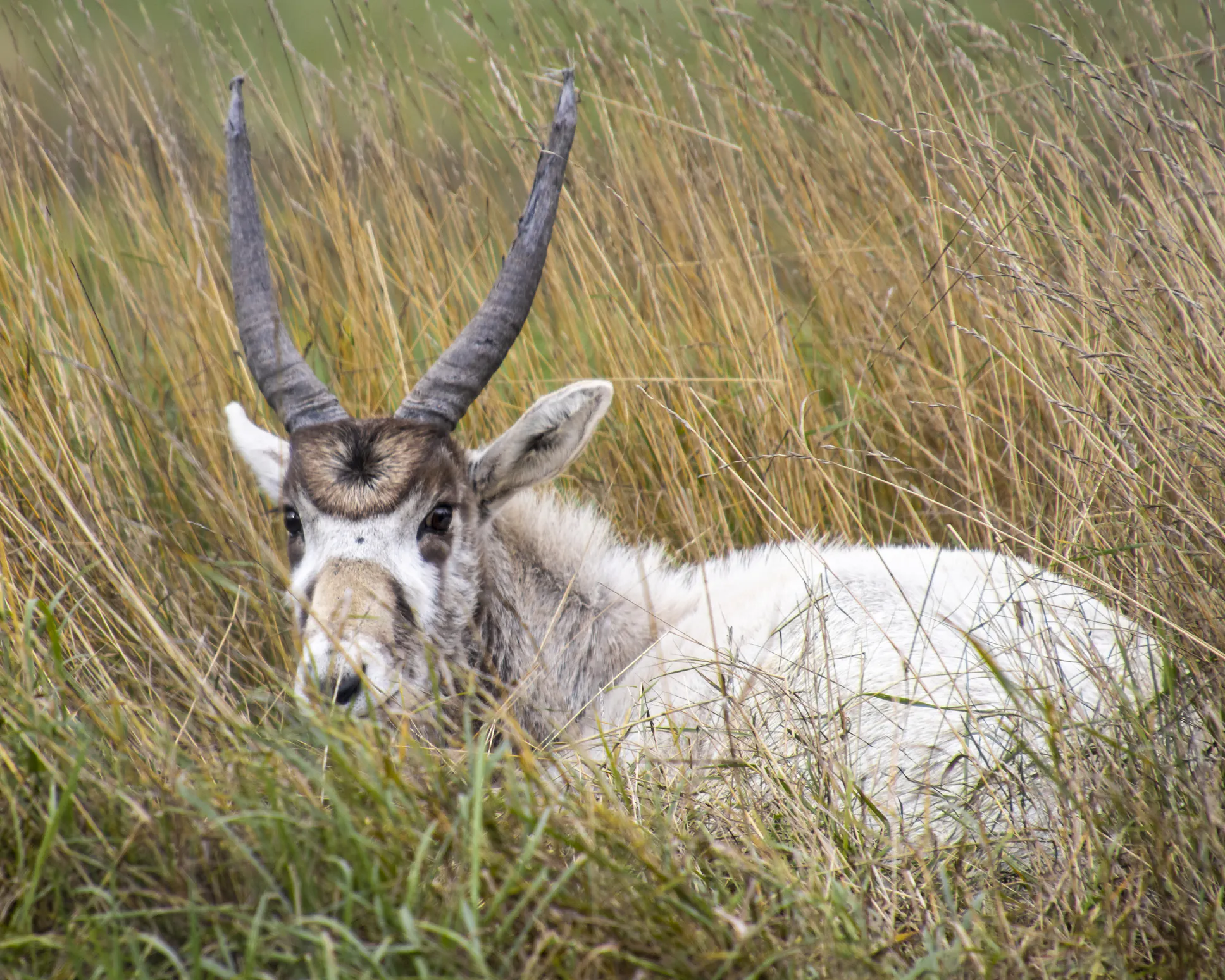
An addax displaying its characteristic facial markings forming a distinct X across the bridge of its nose. Image Credit: © Judit Dombovari, Dreamstime
A selective grazer in a sparse habitat
As a grazer, the addax survives on grasses and the leaves of shrubs, leguminous herbs, and bushes wherever it can find them, with staples including Aristida, Panicum, and Stipagrostis grasses. It only turns to browsing on Acacia leaves when its preferred grasses run out. Perennials that green up after even the slightest humidity or rain also make the menu.
The addax is a surprisingly particular eater. When grazing on Aristida grasses, it crops them neatly down to a uniform height. With Panicum grasses, it ignores the drier outer leaves entirely and targets the tender inner shoots and seeds, which serve as its primary source of protein.
Perhaps most remarkable is what the addax doesn't need: water. It can survive without free-standing water almost indefinitely, drawing moisture instead from the plants it eats and from dew that collects on vegetation overnight.
Researchers believe the addax may have a specialized stomach lining capable of storing water in pouches for use during dry stretches, and it produces highly concentrated urine to conserve every drop. A study tracking food retention in the addax's digestive tract found that food remained there for long periods, possibly as an adaptation to slow-fermenting grasses and water-saving mechanisms.
Herd life and survival strategies
Addax live in mixed herds of five to 20 animals, made up of both males and females and typically led by one dominant male. These herds don't wander far and wide; instead, they stay largely in one place, moving only when the search for food demands it. During summer, herds tend to gather along the northern edge of the tropical rain system, then shift north as winter arrives, effectively tracking rainfall to stay near the freshest vegetation.
To cope with the desert's extreme heat, herds huddle together in shaded areas during the day and rest in sand hollows on cool nights. Both behaviors that help dissipate body heat and conserve water.
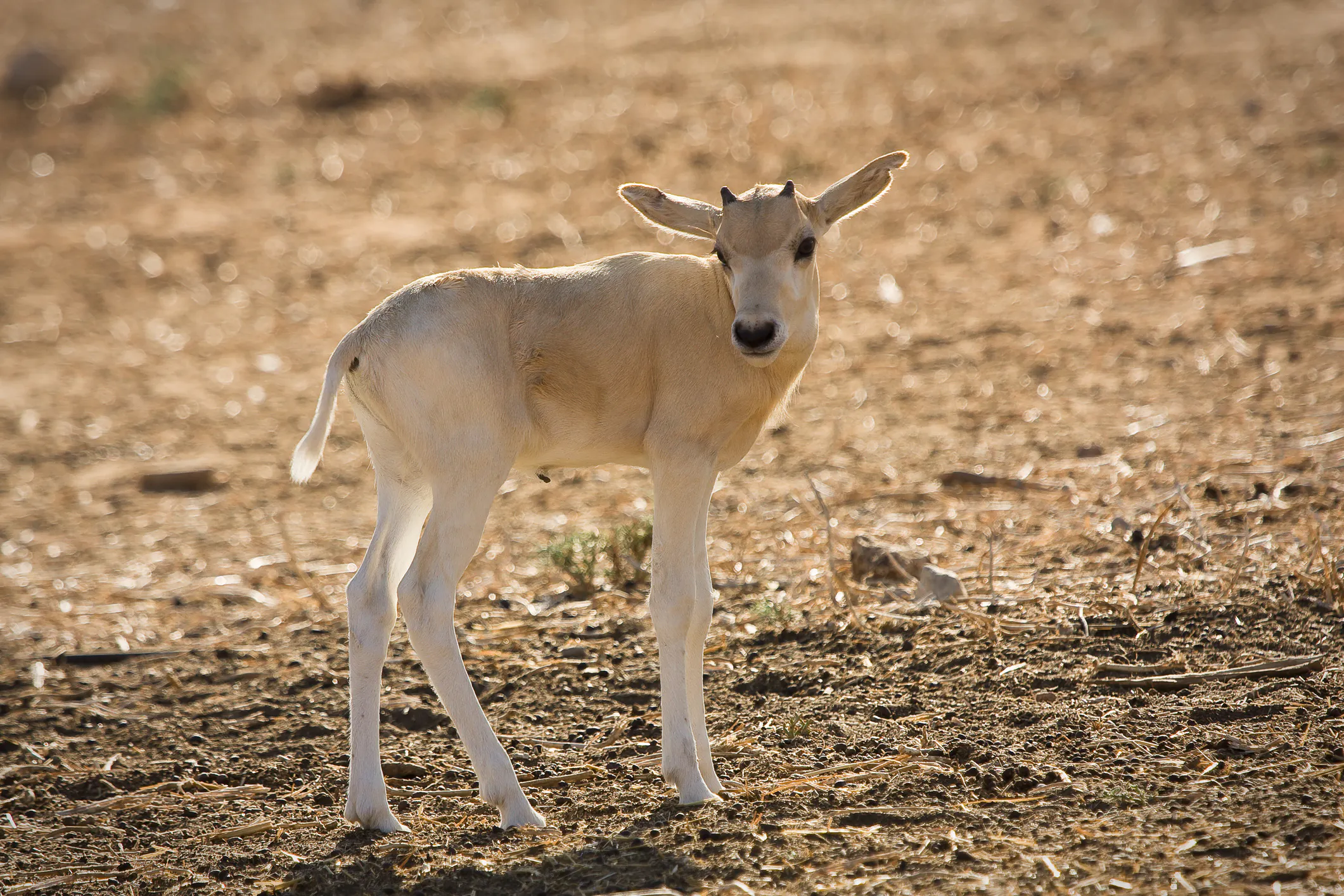
An addax calf. Image Credit: © Smellme, Dreamstime
Breeding, birth, and the first months of life
Female addax reach sexual maturity between two and three years of age, while males mature around age two. Breeding happens year-round but peaks during winter and early spring, though timing shifts slightly by region. In the northern Sahara, breeding peaks near the end of winter into early spring, while in the southern Sahara it peaks from September to October and again from January to mid-April. Each period of estrus lasts just one to two days.
Gestation lasts 257 to 270 days, roughly nine months. Calves weigh about 5 kilograms (11 lb) at birth and are weaned between 23 and 29 weeks old.
In the wild, addax can live up to 19 years, a lifespan that can stretch to 25 years under the protection of captivity.
An animal woven into ancient human history
The addax's relationship with people stretches back thousands of years. Tomb paintings dating to around 2500 BCE depict the ancient Egyptians partially domesticating the addax, showing the animals tethered by rope to stakes alongside other antelope species. The number of addax a person captured was considered an indicator of high social and economic standing in ancient Egyptian society.
Bedouin communities have long referred to the addax by the Arabic name bakr, or bagr, al wahsh, meaning "the cow of the wild," a term also applied more broadly to other ungulates. Some scholars, including Henry Baker Tristram, believe the "pygarg," a white-buttocked animal mentioned in the biblical book of Deuteronomy, was in fact the addax.
Fossil evidence backs up this long history, with addax remains uncovered at several sites across Egypt dating between 4000 and 7000 BCE, as well as at Mittleres Wadi Howar and several Pleistocene sites.
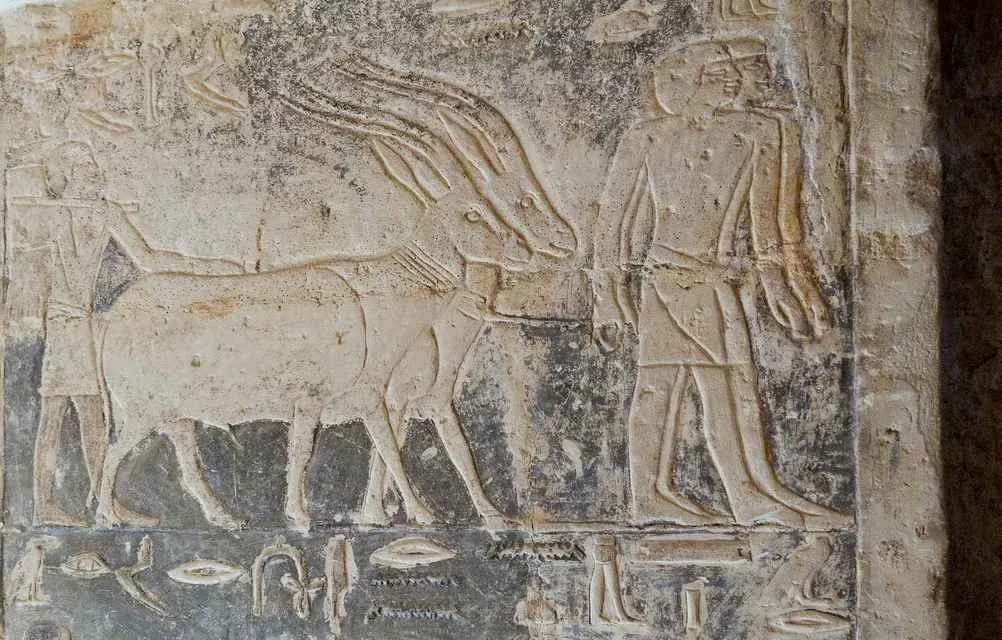
Addax depicted in the Mastaba of Nikauisesi at Saqqara, dating to Egypt's Fifth and Sixth Dynasties. Evidence of the species' early partial domestication. Image Credit: Kairoinfo4u, Flickr
Why the addax is disappearing
The addax has been in decline since the mid-1800s, and the trend has only accelerated. Its slow, plodding movement, once an energy-saving adaptation to desert life, has become a fatal liability in the presence of firearms and vehicles. Overhunting is the single biggest driver of the species' collapse, compounded by roadkill and by nomadic settlements establishing themselves near the waterholes addax depend on during the dry season. The demand for addax meat and leather has only intensified the pressure.
Beyond hunting, the addax faces chronic droughts, habitat destruction from expanding human settlements, and the steady encroachment of agriculture into what was once open desert. Today, fewer than 500 addax are believed to remain in the wild.
Fighting to bring the addax back
The addax is classified as critically endangered on the IUCN Red List, but conservationists have not given up. More than 600 addax now live in managed populations across Europe, the Yotvata Hai-Bar Nature Reserve, Sabratha, Giza Zoo, North America, Japan, and Australia as part of captive breeding programs, with thousands more held in private collections and ranches across the United States and the Middle East.
Legal protections are in place in Morocco, Tunisia, and Algeria, and hunting of all gazelle species is banned outright in Libya and Egypt. Vast protected areas, including the Hoggar Mountains and Tassili in Algeria, the Ténéré in Niger, the Ouadi Rimé-Ouadi Achim Faunal Reserve in Chad, and the newly established Wadi Howar National Park in Sudan, overlap with the addax's historic range, though some lack the resources needed to actively manage addax populations.
Reintroduction efforts are underway on multiple fronts. In 2019, Sahara Conservation partnered with the Environment Agency Abu Dhabi to reintroduce addax to the Ouadi Rimé-Ouadi Achim Faunal Reserve, and a small population now persists there. In 2023, ten addax were relocated to the Ennedi Natural and Cultural Reserve, marking another cautious step toward rebuilding the species' presence across its former range.
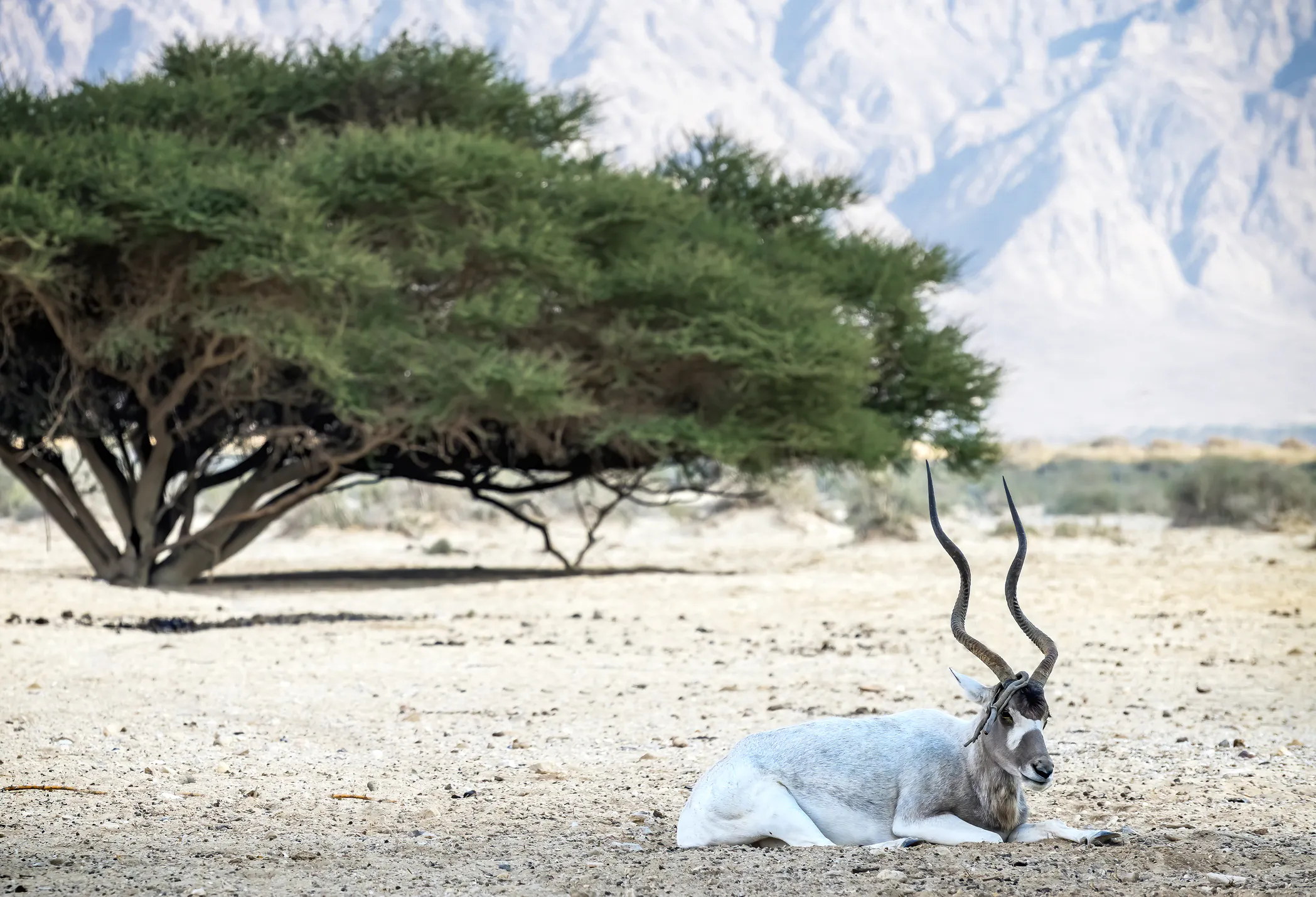
An addax lies at rest in a protected reserve, part of ongoing efforts to reintroduce the critically endangered species to its native range. Image Credit: © Gorshkov13, Dreamstime
A desert icon worth saving
The addax has survived in one of the most unforgiving environments on the planet for thousands of years, adapting so completely to the desert that it barely needs the one resource every other large mammal depends on. What it hasn't been able to adapt to is us.
Its future now rests on the success of the reserves, breeding programs, and reintroduction efforts working to give this quiet, spiral-horned survivor a real chance at reclaiming the sands it once called home.
Explore similar content

Subscribe to receive monthly updates on climate solutions, environmental heroes, and the profound beauty and wonder of our shared planet Earth.
What is an Iconic Species?
One Earth’s Species of the Week series highlights charismatic and ecologically significant animals that represent the diversity of each of our 185 bioregions. These iconic species are part of the One Earth Bioregions Framework. Learn more >