Inside the world of the Galápagos giant tortoise
- Nature Conservation
- Land Conservation
- Iconic Species
- Wildlife
- Reptiles
- Andes Mountains & Pacific Coast
- Southern America Realm

One Earth’s “Species of the Week” series highlights an iconic species that represents the unique biogeography of each of the 185 bioregions of the Earth.
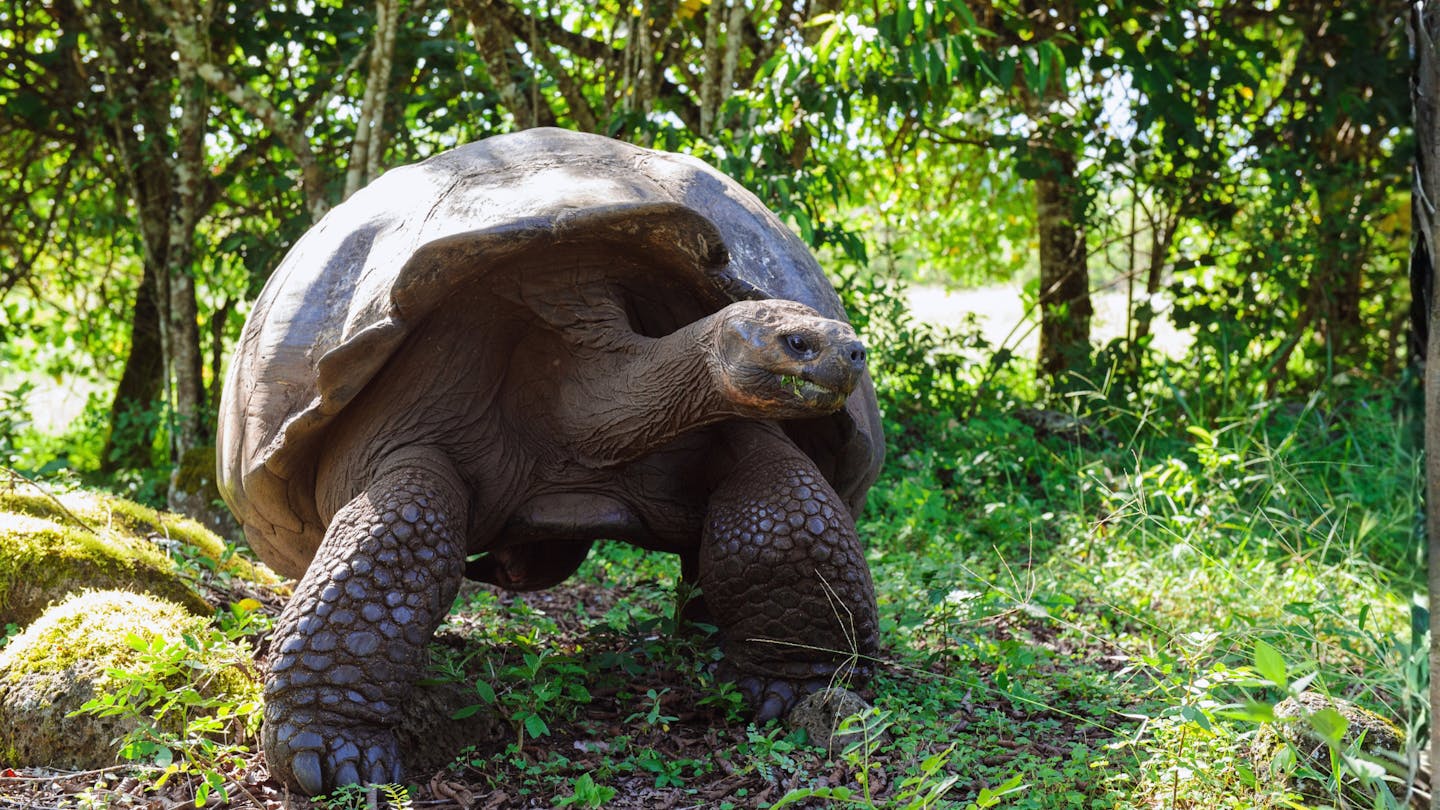
The Galápagos giant tortoise (Chelonoidis niger) has shaped these islands for centuries, moving slowly across volcanic slopes, carving paths through vegetation, and leaving behind landscapes that bear its imprint.
Its story is inseparable from the Galápagos themselves, a living reminder that evolution, ecology, and time unfold together, one step at a time.

In the One Earth Bioregions Framework, Galápagos tortoise are the iconic species of the Galápagos Islands bioregion (NT9), located in the Andes & Pacific Coast subrealm of Southern America.
Seven volcanic islands shaped by wet highlands and dry lowlands
Galápagos tortoises are native to seven islands across the archipelago, and their lives reflect the sharp contrasts of these volcanic landscapes. On larger, wetter islands, tortoises migrate seasonally between lowland plains in the wet season and higher, cooler elevations during the dry months. Over generations, these movements have etched visible trails through the vegetation, known as tortoise highways.
On smaller, drier islands, food is scarcer and conditions more extreme. Across this patchwork of habitats, Galápagos tortoises have evolved into island-tuned lineages rather than a single uniform form. Today, the species includes 15 subspecies in total, 12 still living and three lost to history.
Spanish explorers arriving in the 16th century named the islands for these animals, using the word galápago, meaning “tortoise.” Centuries later, the same creatures would help spark a deeper realization.
As Charles Darwin observed, tortoises on neighboring islands looked similar at a glance, yet differed in meaningful ways. Those subtle variations hinted at how isolation and environment shape life over time, insights that would later inform evolutionary thinking.
Giant bodies and shells built for island life
A Galápagos tortoise carries its architecture on its back, and its scale is impossible to miss. It is the largest living species of tortoise, with the heaviest individuals reaching up to 417 kilograms (919 lb) and stretching nearly 1.9 meters (6.1 ft) in length. Built for endurance, these animals can live more than a century in the wild, with some individuals in human care recorded at well over 170 years.
Its shell is a rigid, bony structure fused to the ribs and spine, forming both armor and skeleton. Lichens often grow across its surface, a quiet marker of slow movement through time. When threatened, a tortoise can withdraw its head, neck, and forelimbs fully inside. Thick, column-like legs support its weight, with five claws on the front feet and four on the back.
This combination of size, strength, and longevity has allowed Galápagos tortoises to persist through droughts, volcanic change, and centuries of human pressure.
A herbivore that eats cactus and survives on dew
Galápagos tortoises are herbivores with broad diets that include grasses, leaves, fruits, lichens, and cacti. Juveniles consume a significant portion of their body weight each day as they grow.
Water comes largely from vegetation, especially Opuntia cactus, allowing tortoises to survive for months without drinking. On arid islands, they lick morning dew from rocks, a behavior repeated over generations that has carved smooth depressions into stone.
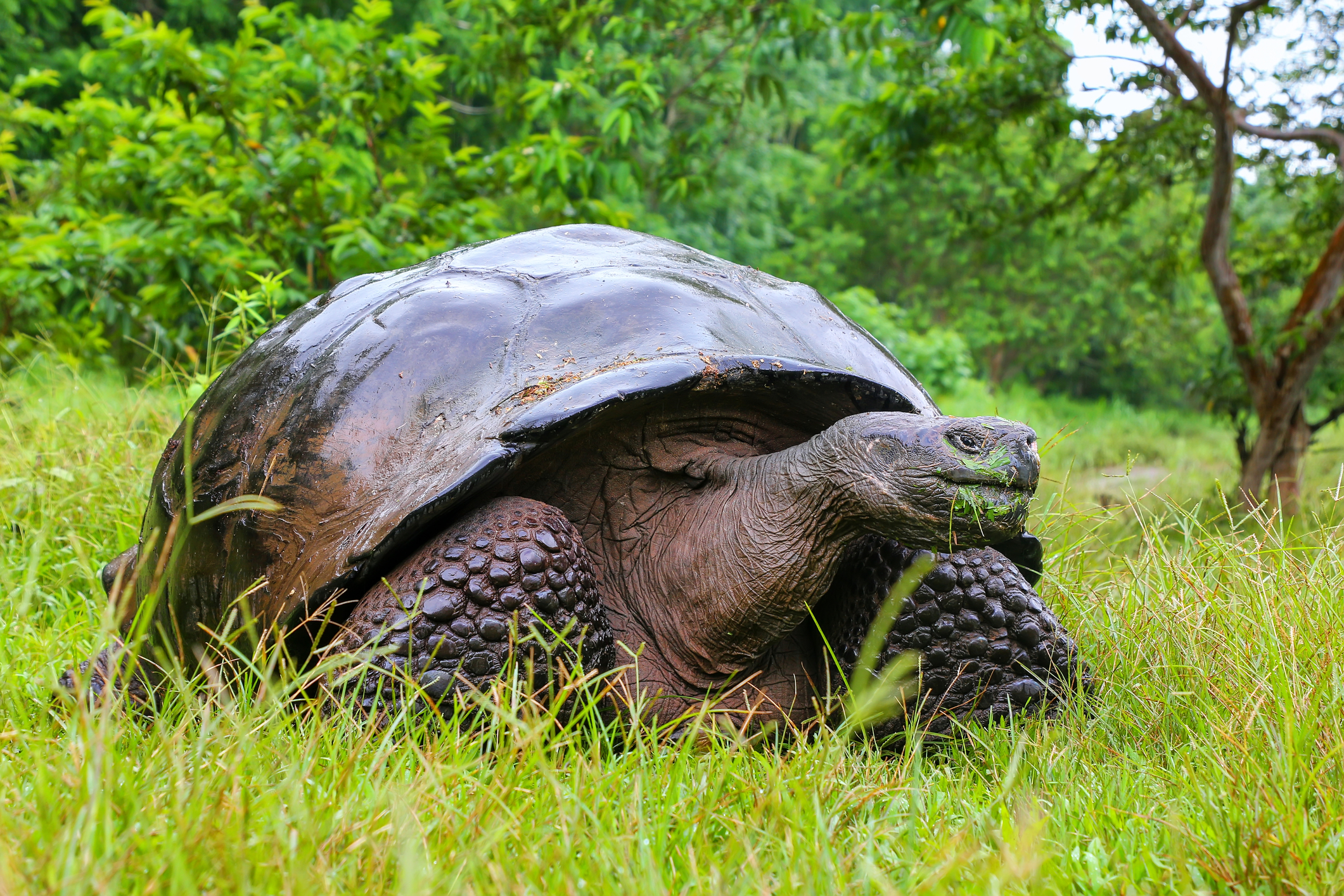
Galápagos giant tortoise on Santa Cruz Island in Galápagos National Park, Ecuador. Image Credit: © Donyanedomam, Dreamstime.
Ecosystem engineers that move seeds and shape plant communities
Tortoises do more than feed. They are keystone species that shape ecosystems through grazing, trampling, and seed dispersal. By thinning dense vegetation, they allow light to reach the ground and support new plant growth.
They also form unexpected partnerships. Finches and mockingbirds groom tortoises, feeding on parasites while the tortoises benefit from the attention. These interactions ripple outward, influencing insects, birds, and plant communities across the islands.
Daily routines, seasonal migrations, and tortoise highways
As cold-blooded animals, tortoises begin each day basking in the sun before foraging for hours at a steady pace. On wetter islands, they move between elevations with the seasons, following routes used for generations.
Some gather in loose groups, while others remain solitary. They cool themselves in mud wallows and shallow pools, dust bathe to deter parasites, and rest at night in sheltered depressions worn into the earth.
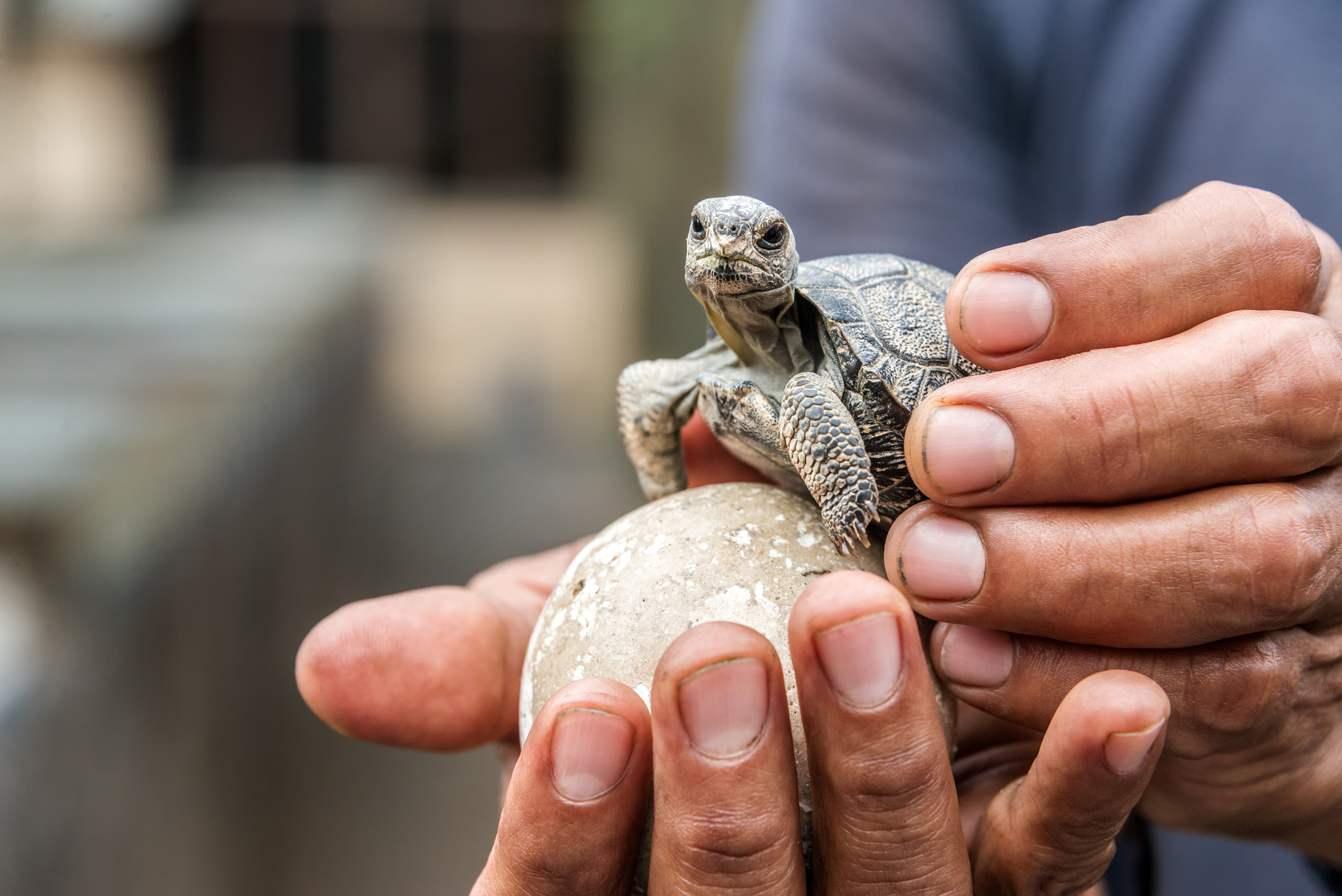
Baby Galápagos tortoise on Isabela Island Reserve, Ecuador. Image Credit: © Jesse Kraft, Dreamstime.
Courtship contests, hard-shelled eggs, and a slow path to adulthood
Mating can occur year-round, with seasonal peaks in wetter uplands. Males compete through dramatic dominance displays, stretching their necks skyward until one yields.
Females travel long distances to nest in sandy coastal areas, digging deep chambers with their hind legs and laying clutches of hard-shelled eggs. Incubation temperature influences hatchling sex, and emergence can take months. Hatchlings face steep odds from predators and environmental stress, and those that survive grow slowly, reaching maturity decades later.
Threats from exploitation, invasive mammals, and habitat loss
Human arrival dramatically altered the fate of Galápagos tortoises. Centuries of hunting, habitat conversion, and introduced animals reduced populations from hundreds of thousands to just a fraction of their former numbers by the 20th century. Eggs and hatchlings were especially vulnerable to rats, pigs, and dogs.
Even today, slow growth, late maturity, and island isolation make recovery fragile in the face of poaching, development, and tourism pressure.
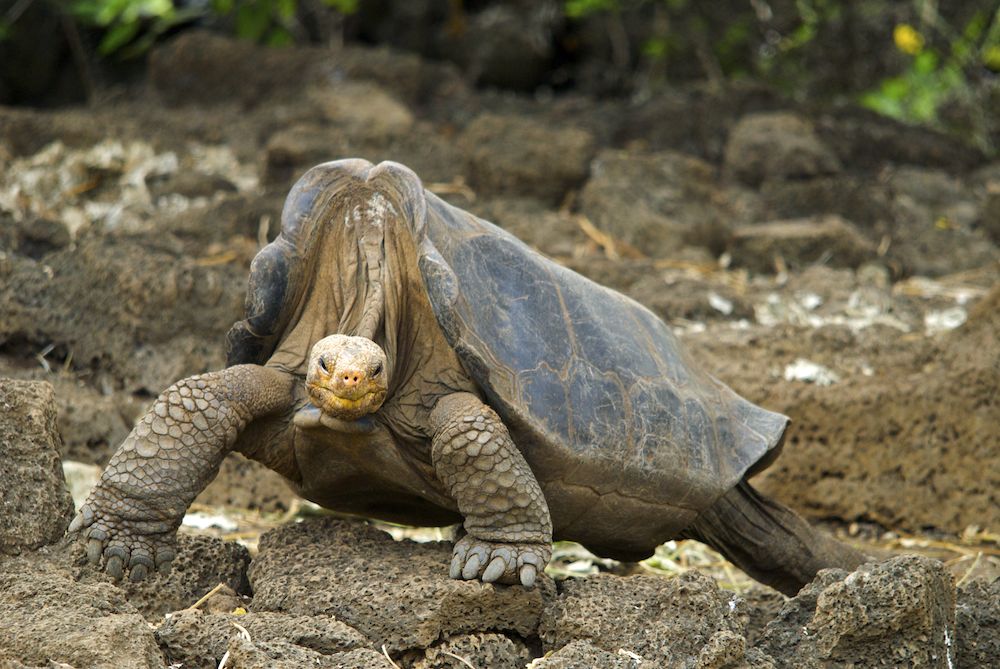
As the last known Pinta Island tortoise, Lonesome George came to represent both the consequences of ecological loss and the responsibility of long-term conservation. Image Credit: Arturo de Frias Marques, Wiki Commons.
Conservation status and the long work of bringing tortoises back
All surviving subspecies of Galápagos tortoise are classified as Threatened, and some lineages are gone forever. The death of the famous Lonesome George in 2012 marked the loss of the Pinta Island subspecies.
Yet long-term conservation has brought real gains. Strict legal protections, captive breeding, and head-start programs have rebuilt populations on several islands. On Española, a population once reduced to just 14 adults now numbers more than 1,000. Island restoration efforts have removed invasive species and reopened habitats to natural recovery.
Ongoing research, including satellite tracking, continues to guide protection efforts by revealing how tortoises move across landscapes and respond to seasonal change.
A future measured in centuries
With lifespans that routinely exceed 100 years, Galápagos giant tortoises experience environmental change on a scale few animals can match. Their recovery does too.
Decades of protection and restoration are beginning to revive not just a species, but the systems it sustains. As tortoises return to islands where they once vanished, their slow paths are reshaping the land, reminding us that caring for nature often means thinking in centuries, not years.
Explore similar content

Subscribe to receive monthly updates on climate solutions, environmental heroes, and the profound beauty and wonder of our shared planet Earth.
What is an Iconic Species?
An iconic species is a charismatic and ecologically significant animal selected to represent the unique biogeographical diversity of each bioregion in One Earth's Bioregions Framework. Learn more >
.jpg?auto=compress%2Cformat&h=600&w=600)
.jpg?auto=compress%2Cformat&h=600&w=600)