
Limiting Overshoot: A new UN climate report demands radical change
- Energy Transition
- Nature Conservation
- Regenerative Agriculture
- Social Justice
- Nature/Climate Finance
- Policy & Governance

The world is now expected to cross 1.5°C of long-term global warming, likely within the next few years.
That is the stark conclusion of a new report from the United Nations Environment Programme (UNEP). Limiting Overshoot: Navigating exceedance of 1.5°C and pathways toward return confronts a climate reality that is increasingly difficult to avoid. Even under an optimistic scenario in which current national climate plans and additional net-zero targets are fully implemented, global temperatures are expected to peak around 1.8°C above pre-industrial levels. Most scenarios rise higher.

There is no minimizing what this means.
Above 1.5°C, extreme weather intensifies, ecosystems face growing losses, and risks to human health, food security, water supplies, infrastructure, cities, and economies increase with every additional fraction of a degree.
The risk of triggering potentially irreversible changes also rises, including destabilization of major ice sheets, degradation of the Amazon rainforest, and disruption of the Atlantic Meridional Overturning Circulation, a major system of ocean currents that helps regulate Earth’s climate.
But the report is not an argument for resignation.
It is an argument for transformation.
Overshoot is a pathway, not a destination
For years, much of global climate policy has focused on preventing temperatures from exceeding 1.5°C above pre-industrial levels.
UNEP now says the world must prepare for a different trajectory: overshoot, peak, and decline.
“As every fraction of warming matters, all hope is not lost if we surpass 1.5˚C. The closer we can stay to this target, the better chance we have at securing a future that leaves room for thriving societies and functioning ecosystems. The story of climate action is not just about avoiding collapse; it is about building a better world." — Spencer Scott on the One Earth Razor’s Edge Climate Model.
Rather than imagining 1.5°C as a line that, once crossed, renders further action meaningless, the report describes overshoot as a pathway. Temperatures rise above 1.5°C, eventually reach a peak, decline, and ideally stabilize at or below the Paris Agreement target of 1.5°C.
The shape of that curve matters enormously.
A world that peaks at 1.8°C and returns relatively quickly is profoundly different from one that exceeds 2°C and remains there for decades. Every fraction of a degree increases climate risks. Every additional year of overshoot increases exposure to those risks.
The downward side of the curve is not guaranteed. It depends on decisions being made now and sustained for decades to come.
That makes the new climate imperative clear: keep the peak as low as possible, make the overshoot as short as possible, and build the conditions necessary to bring temperatures back down.
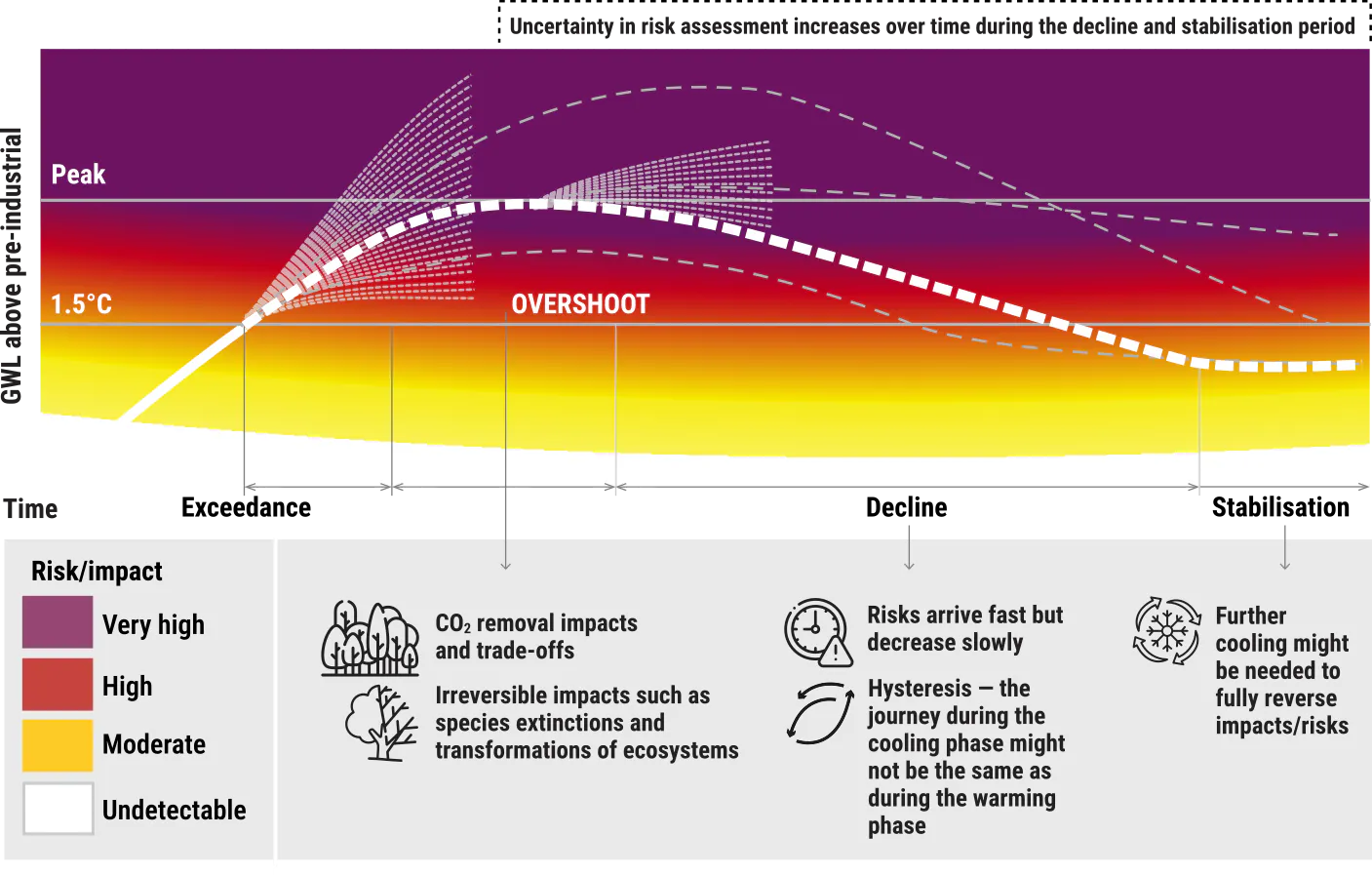
Potential impacts. Image Credit: Limiting Overshoot, UNEP.
Incremental change is no longer enough
If overshoot is a pathway, then every system that shapes that pathway matters.
Many of the systems built for a relatively stable climate are no longer sufficient for the world ahead. UNEP’s response therefore reaches beyond any single technology or sector. Strong political will, effective policies, inclusive governance, finance, international cooperation, equity, and justice are all identified as necessary conditions for success. Countries with greater responsibility for climate change are called on to move fastest and with the greatest ambition.
The path forward depends on how quickly the world can cut emissions, adapt to impacts already underway, reduce vulnerability, and create the conditions needed to eventually bring temperatures back down.
That requires action across the systems that shape both the climate crisis and our capacity to respond to it.
The Energy Transition must accelerate
The clearest place to begin is the global energy system.
UNEP calls for immediate and sustained reductions in greenhouse gas emissions, including methane, alongside a rapid transition away from fossil fuels. The report warns against continuing to build long-lived, high-emissions infrastructure such as fossil fuel power plants, transport systems, and industrial facilities that could lock in pollution for decades to come.
Existing and planned fossil fuel infrastructure alone could produce carbon dioxide emissions far beyond levels consistent with limiting warming to 1.5°C in 2030.
At the same time, renewable energy must expand dramatically.
In limited-overshoot scenarios cited in the report, renewables grow to around 60 to 70% of global electricity generation by 2030, supported by grid expansion, energy storage, and more flexible electricity demand.
This shift offers benefits far beyond reducing global temperatures. UNEP points to cleaner air, improved public health, lower energy costs, and expanded access to electricity as additional gains from rapidly moving away from fossil fuels.
The scale of change required is larger than replacing one energy source with another. It means building an energy system around clean generation, modern grids, storage, and resilience while avoiding new infrastructure that locks communities into decades of additional emissions.
Nature Conservation and restoration must strengthen ecosystem resilience
Nature is not only at risk from overshoot. Healthy ecosystems are also part of our capacity to withstand it.
Limiting Overshoot warns that some of the world’s least resilient ecosystems could experience irreversible damage as temperatures rise, including coral reefs, polar and mountain ecosystems, and coastal systems. Human pressures such as habitat fragmentation, deforestation, and landscape change are already weakening that resilience, making ecosystems even more vulnerable to additional warming.
Conservation therefore becomes an essential part of climate resilience. UNEP calls for strengthening and expanding protected-area networks, increasing ecological connectivity across land and sea, and adopting proactive conservation strategies that can respond as species shift their ranges in a changing climate.
Restoration is equally important, but the approach matters. The report warns that poorly designed nature-based solutions can harm biodiversity and ecosystem functioning, while natural forest restoration can strengthen carbon storage and support the ecosystems on which adaptation depends.
In an overshoot world, conservation and restoration are not separate from climate resilience. Protecting intact ecosystems and rebuilding degraded ones helps preserve the natural systems that store carbon, regulate water, support biodiversity, and give both people and wildlife more capacity to adapt.
Regenerative Agriculture must move from solution to standard practice
Agriculture is both deeply vulnerable to climate change and an important part of the emissions challenge.
Limiting Overshoot specifically points to the need to reduce hard-to-abate methane emissions from agriculture. It also identifies dietary shifts as one way to significantly cut emissions while freeing land that could be used for carbon storage.
The broader food system underscores how much is at stake. Agriculture accounts for a large majority of tropical deforestation, while the industrial food system produces roughly one-third of global greenhouse gas emissions. Modern agricultural practices have also released vast stores of carbon previously held in soils.
Addressing those impacts means reconsidering how food is produced, how land is managed, how soils and ecosystems are restored, and how agricultural landscapes can remain productive as drought, flooding, heat, and other pressures intensify.
For One Earth, that broader challenge points directly toward Regenerative Agriculture: approaches that can reduce climate impacts while strengthening food security, restoring soils and ecosystems, and making farms and communities more resilient.
In a world moving beyond 1.5°C, the goal cannot simply be to keep producing food under worsening conditions. Agricultural systems must also help rebuild the ecological resilience on which food production itself depends.
Adaptation must become transformational
Even the fastest emissions cuts cannot erase the warming and disruption already underway.
That means mitigation and adaptation can no longer operate as separate areas of climate action. UNEP says they must advance together because each influences the success of the other. Adaptation today can preserve our ability to respond tomorrow, while insufficient mitigation could eventually push some communities and ecosystems beyond the point where adaptation remains possible.
But the report is also clear that adaptation itself has to change.
Small, technical adjustments will not be sufficient for the scale and unpredictability of the risks ahead. UNEP calls instead for “transformational adaptation,” which goes beyond infrastructure to address the underlying drivers of climate vulnerability. This can involve fundamental changes to social and ecological systems, including their structures, priorities, goals, and values.
Preparing for a hotter world cannot mean responding to each disaster as it arrives. It means asking why some communities, ecosystems, and economies are more exposed in the first place and changing those conditions.
Transformational adaptation is ultimately about more than bracing for worsening conditions. It means building communities, landscapes, institutions, and infrastructure capable of functioning in a climate unlike the one for which they were originally designed.
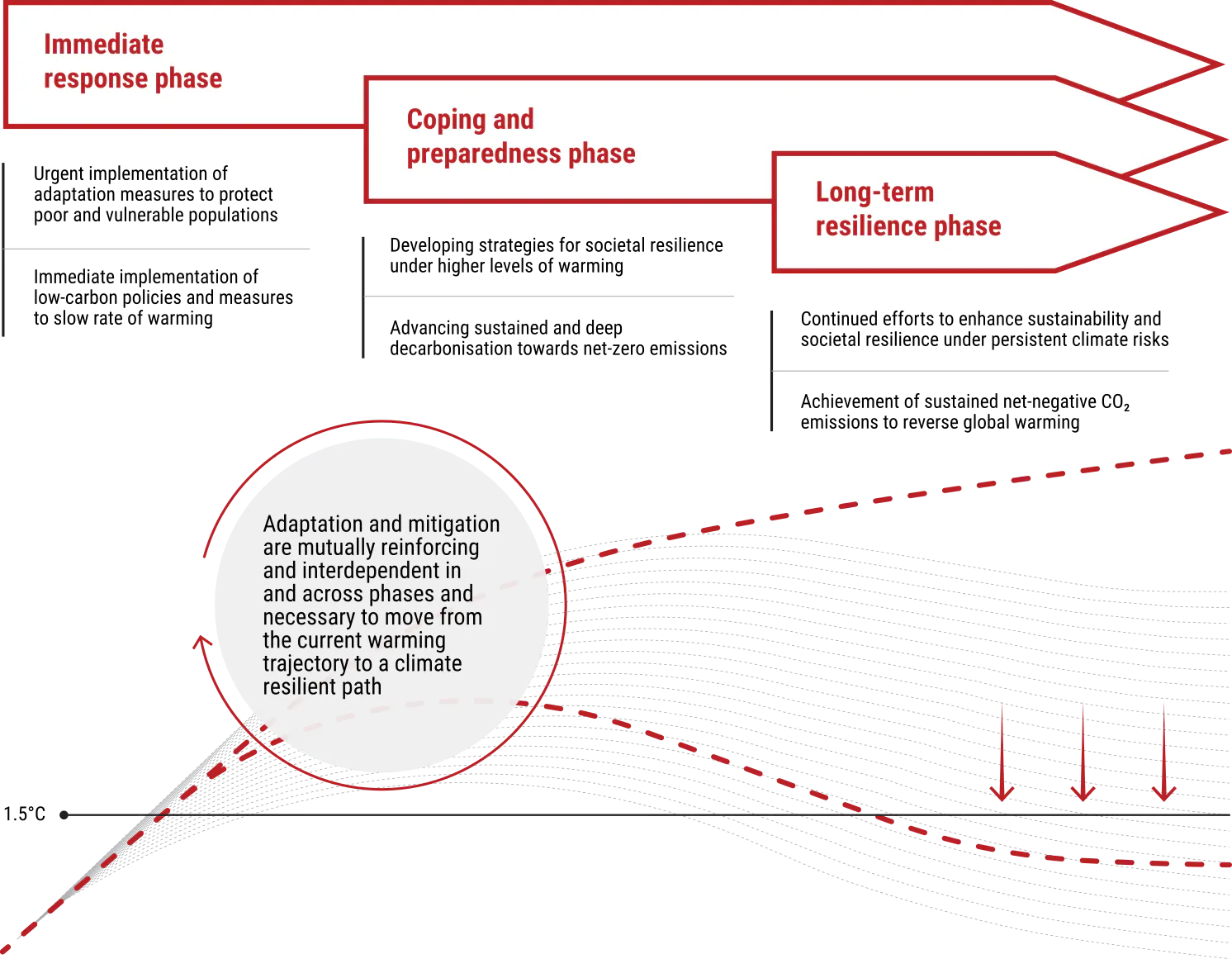
Adaptation and mitigation. Image Credit: Limiting Overshoot, UNEP.
Social justice and equity must guide the response
Climate change is not experienced equally, and neither can its solutions be.
UNEP explicitly states that equity and justice must underpin responses to overshoot. Countries with greater responsibility for climate change should act fastest and with the greatest ambition. That principle becomes even more important as the world moves into conditions that may permanently alter communities and ecosystems.
Even if temperatures eventually return below 1.5°C, UNEP warns that some impacts may be irreversible. Communities may be forced to relocate or change livelihoods, and societies will have to navigate permanently altered conditions.
Who is protected first? Who has the resources to adapt? Who bears the costs of losses and relocation? What happens when a community reaches the limits of adaptation? Who gets to decide what is protected, rebuilt, restored, or left behind?
These are not side questions to the climate crisis. They are central to how societies navigate it.
A radically different climate response must therefore do more than lower the global temperature curve. It must protect the people and communities facing the greatest risks while recognizing that responsibility for creating the crisis, and the resources available to respond to it, are deeply unequal.
Finance and governance must match the scale of the challenge
Knowing what needs to happen is only part of the problem. Solutions also need the financing, policies, institutions, and governance required to implement them at scale. UNEP identifies strong political will and multilateral cooperation, effective policies, inclusive governance, and finance as essential conditions for limiting overshoot.
Those conditions are what allow countries to rapidly build renewable energy, strengthen resilience, improve agricultural systems, protect ecosystems, and help communities prepare for climate impacts. They are also critical to how emerging approaches such as carbon dioxide removal, or CDR, are used.
Bringing global temperatures back down will eventually require sustained net-negative CO₂ emissions, meaning humanity removes more carbon dioxide from the atmosphere than it releases. Approaches range from ecosystem-based practices such as afforestation and soil management to emerging technologies.
But UNEP is explicit that CDR cannot become a substitute for rapidly cutting emissions.
Even optimistic scaling is expected to reverse only a few tenths of a degree of warming this century. Large-scale deployment also comes with questions about cost, land, permanence, environmental integrity, and equity.
Strong, long-term governance will therefore be essential to ensure carbon removal is deployed responsibly and that efforts to reverse warming do not create new environmental or social harms.
Finance and governance may sound less tangible than solar panels, restored forests, or resilient farms, but they determine which solutions get built, how quickly they accelerate, and who benefits from them.
One Earth’s Solutions Framework recognizes this directly. Nature/Climate Finance and Policy & Governance are two Levers of Change that help move solutions across Energy Transition, Nature Conservation, and Regenerative Agriculture from ideas to implementation. Just as important as identifying the solutions themselves are the levers that help scale them, directing capital, policy, and action toward the approaches with the greatest potential for impact.
Holding both truths
Limiting Overshoot asks us to hold two realities at once.
The world is going to get harder before the curve bends back down.
And the shape of that curve is still something we can influence.
Every fraction of a degree avoided reduces climate risk. Every year the overshoot is shortened reduces exposure. Every investment in resilience preserves more options for the future.
Crossing 1.5°C does not mean that 1.6°C and 2°C are interchangeable. It does not mean emissions reductions matter less. It does not mean adaptation is futile. And it certainly does not mean our opportunity to build a safer future has disappeared.
The report points to what needs to happen: rapidly cut greenhouse gas emissions, accelerate renewable energy, reduce methane, reshape agriculture and adaptation, strengthen resilience, mobilize finance, govern emerging technologies carefully, and put equity at the center of decision-making.
Many of these solutions already exist. The challenge is increasingly not a lack of knowledge, but the gap between what we know must happen and the political will, investment, coordination, and speed required to make it happen.
There is hope in this.
The work ahead is extraordinarily difficult, but it is not unknowable. It is the human work of organizing, financing, governing, building, restoring, and choosing to move toward the safer end of the curve.
That is what radical transformation looks like.
Not one dramatic pivot, but thousands of consequential choices across energy systems, farms, cities, ecosystems, governments, financial institutions, and communities.
We may no longer be able to prevent every disruption ahead. But we can still determine how much we prevent, how much we protect, and the new world we build through it.
Explore similar content

Subscribe to receive monthly updates on climate solutions, environmental heroes, and the profound beauty and wonder of our shared planet Earth.
.jpg?auto=compress%2Cformat&h=600&w=600)